Having two kids is naturally a breeding ground for comparison. I can only imagine what it must be like to have twins or to be a twin, where the comparison is even more intense. But I think that it's a natural human thing to use past experience to find your way through the present, so I've found myself comparing a lot of what Todd and Vicki do, and thinking about what circumstances may have brought about the divergences between them.
The conclusion I've pretty much come to? Parenting doesn't make all that much difference!
Vicki Jo came into the world in a surprising, sudden way, and everything about her has been intense and sensitive ever since. She is a natural actress and can turn on the tear faucet as fast as anyone I've ever seen (and turn it off just as quickly). I like to joke that she still cries more than Todd, at 2 1/2 years old (it's not really a joke, because it's true). Before she became so verbal, there were many times as her parent that I simply could not figure out what to do to make her happy. We spent many evenings crying together. And yes, that is as depressing as it sounds.
She was slow to develop in every way except one: talking. She is remarkably verbal, has a huge vocabulary, and is on a fast track to reading early. I know, this kind of parental bragging is nauseating. But let me counterbalance that by saying that she was painfully slow to roll, sit up, crawl, pull up, and walk. I often wondered whether she might need some therapy. She didn't get her first tooth until she was nearly 12 months old.
Looking back, the single biggest hurdle to her development in all of this had to have been her temperament. She would not be put down. If you did put her down, and ignored her screaming, she refused to do any kind of active work to further her physical development. She wanted to be held and talked to. Even still, she does not like working or playing by herself. She does not "entertain herself." She needs interpersonal stimulation.
Todd, on the other hand, took his very sweet time in being born, and I had to semi-evict him even when it was past time. He was born much larger (8 lb 12 oz to Vicki's 7 lb 1 oz), and 16 days later than she was, in terms of the length of the pregnancy. He has been content to wait and observe ever since. Other than necessarily having to leave him on the floor more often, just because I have another child to tend to, I do very little differently than I did with Vicki. And yet, he has wanted to be on his own. He has wanted for me to stop interacting with him sometimes.
This has led to a stark difference in his development. He began inching around in his fourth month, was easily crawling by six, and now, at seven months on Monday, has begun to pull up to a stand on my legs and the walls. He cut his first tooth last week, with very little fanfare. He loves nothing more than to be set free to crawl around the house and explore it by himself.
Like I said, I followed no kind of program to get Todd to meet milestones so much earlier than Vicki did. The only difference in me is that I have had an infant before. Perhaps my lack of anxiety about his development contributed to his easy personality. But I think he may have just been this way, regardless.
So the moral of the story? Don't give yourself so much credit as a parent. These kids pretty much figure things out themselves!
Showing posts with label montessori. Show all posts
Thursday, December 12, 2013
Tuesday, September 24, 2013
king's daughters
When Jeff decided to enter rehab at the end of April, I was faced with an immediate dilemma. He had been a full-time caretaker for our daughter, and she needed somewhere to spend her days while I was at work! If only baby Todd had been more considerate of our schedule, I could have kept them both during my maternity leave (okay, that actually sounds like a nightmare, but I know that lots of moms do it!). However, he still had a month more to cook, unbeknownst to me at the time!
She came with me to work for a week or two. You know what is exhausting for a 38-week-pregnant lady? Trying to keep your toddler from misbehaving at work while simultaneously getting any work done. So when Jeff's grandmother (our beloved Memaw) called and said a spot had opened up at King's Daughters and offered it to Vicki Jo, I rejoiced to the heavens.
Let me explain a little bit. King's Daughters Day Home is a non-profit preschool started in 1965 to serve low-income families in Madison, TN. (This is the northern suburb of Nashville where my church is and Memaw lives.) The International Order of The King's Daughters and Sons is a religious philanthropic organization that I'd never heard of before meeting Memaw. Their goal is to "lend a hand in service." Um, yeah. I think you could say they have done this for our family!
Memaw is a King's Daughter. She has been one for a long time. She works very part-time at the Day Home as part of their development team (sidenote: the woman is 83 and still works because she wants to!). The Day Home is not just any preschool. Every person that works there has a college degree - most of them in early education and development. Some of them have or are working on advanced degrees. They care deeply about the education and emotional well-being of their small charges. And it shows. They make an effort to learn about each home environment (some of which are very troubled). They incorporate elements of Montessori and Reggio education into their lesson plans, which are posted on the wall near the student folders for all to see.
They offer superb education for young people at a marginal, sliding-scale cost based on income. They get lots of grants and are always actively seeking donations. They accept children starting at age 2 1/2 and potty-trained.
But Vicki Jo was neither of these things. She had just turned two on April 2, and was just beginning to tell us when she needed to use her potty. They took her anyway, mostly because of Memaw. And they knew that our situation was pretty pressing.
It has been one of the best things that has happened to our family. They took Vicki in and basically potty trained her for me. She is now totally dry during the day. She is learning so much. She tells me every day about new language and math skills she is picking up. I hear daily about each of her friends in class - Jorge and King and Ciara and Autumn and Micah - and her teachers, Ms. Jasmine and Ms. Sonya.
Vicki has a hard time going to school in the morning. She still cries a little when I drop her off. But they tell me that she is fine after a minute or two. And when I come to get her in the afternoon, she is playing joyfully, and has all the adults wrapped around her finger. I cannot wait until they open their Infant-Toddler Center next spring, and Todd gets a chance to be at King's Daughters too!
She came with me to work for a week or two. You know what is exhausting for a 38-week-pregnant lady? Trying to keep your toddler from misbehaving at work while simultaneously getting any work done. So when Jeff's grandmother (our beloved Memaw) called and said a spot had opened up at King's Daughters and offered it to Vicki Jo, I rejoiced to the heavens.
Let me explain a little bit. King's Daughters Day Home is a non-profit preschool started in 1965 to serve low-income families in Madison, TN. (This is the northern suburb of Nashville where my church is and Memaw lives.) The International Order of The King's Daughters and Sons is a religious philanthropic organization that I'd never heard of before meeting Memaw. Their goal is to "lend a hand in service." Um, yeah. I think you could say they have done this for our family!
Memaw is a King's Daughter. She has been one for a long time. She works very part-time at the Day Home as part of their development team (sidenote: the woman is 83 and still works because she wants to!). The Day Home is not just any preschool. Every person that works there has a college degree - most of them in early education and development. Some of them have or are working on advanced degrees. They care deeply about the education and emotional well-being of their small charges. And it shows. They make an effort to learn about each home environment (some of which are very troubled). They incorporate elements of Montessori and Reggio education into their lesson plans, which are posted on the wall near the student folders for all to see.
They offer superb education for young people at a marginal, sliding-scale cost based on income. They get lots of grants and are always actively seeking donations. They accept children starting at age 2 1/2 and potty-trained.
But Vicki Jo was neither of these things. She had just turned two on April 2, and was just beginning to tell us when she needed to use her potty. They took her anyway, mostly because of Memaw. And they knew that our situation was pretty pressing.
It has been one of the best things that has happened to our family. They took Vicki in and basically potty trained her for me. She is now totally dry during the day. She is learning so much. She tells me every day about new language and math skills she is picking up. I hear daily about each of her friends in class - Jorge and King and Ciara and Autumn and Micah - and her teachers, Ms. Jasmine and Ms. Sonya.
Vicki has a hard time going to school in the morning. She still cries a little when I drop her off. But they tell me that she is fine after a minute or two. And when I come to get her in the afternoon, she is playing joyfully, and has all the adults wrapped around her finger. I cannot wait until they open their Infant-Toddler Center next spring, and Todd gets a chance to be at King's Daughters too!
Thursday, April 18, 2013
table for two
One of the things I hemmed and hawed and dragged my feet about was buying a first table and chair for Vicki. This is sort of an essential piece of Montessori home equipment, to be used for meals, work, and other independent activities. It's helpful because it allows the child to delineate whatever experience they are having: eating your yogurt? Go sit at your table. Want to do some transferring with tongs? Take the work to your table. It provides a beginning and ending point for the activity.
Michael Olaf recommends a very specific first table and chair, ergonomically fitted to the infant. I never bought these, because I really wanted something that would last a bit longer for Vicki Jo, size-wise.
For her 2nd birthday, Jeff and I got her the table and chairs you see above. They are KidKraft, which is one of my favorite brands of children's furniture. Jeff did the assembly - pretty quick compared to some other items. You can see that it's still a touch big for her. She can get into the chairs easily, but needs help pushing them up to the table. I'm okay with this, as it means she will be able to comfortably sit there for at least another year or two.
There was really only one place in our small kitchen that the table and chairs could go. We put them right in front of the big window. Now Vicki has a spot of her very own to sit, gaze out at the neighborhood kitties and house building adventures, drink her milk, and not be quite so underfoot in the morning. We both love it.
Friday, April 12, 2013
the newborn toy box
We are in the final stages of preparing our home and our stuff to receive baby Todd. Of course, there is no real "getting ready." If there's one thing I learned the first time around, it's not to get too ready, because you'll have to change everything anyway.
But we got down the little cradle, the rocker, the nursing footstool. We filled up a basket with diapers and wipes and other things we will need to change him. And I sorted through the clothes, washed them, and got him a drawer ready in my dresser.
I also went through an old box of Vicki's toys and materials that she has outgrown. Now, let's be honest: newborns don't need toys! They need holding and nursing and changing and feeding. But having a little cigar box of items to help entertain him seems like a good idea.
Here's what I've got:
Clockwise from top left: perfect pacifier from Michael Olaf, Plan Toys roller, a teether and a rattle from Little Alouette, Haba clutching beads, beads on a string (part of a 5-piece set from Pinkhouse Toys), and a wooden rattle I found on Amazon. I only bought the Haba beads and the rattle from Amazon new. Vicki had the beads and loved them, but we lost them somewhere along the way.
We also have some high-contrast black and white art cards for observing or hanging. And of course our assortment of board books. It's so nice not having to start from scratch!
But we got down the little cradle, the rocker, the nursing footstool. We filled up a basket with diapers and wipes and other things we will need to change him. And I sorted through the clothes, washed them, and got him a drawer ready in my dresser.
I also went through an old box of Vicki's toys and materials that she has outgrown. Now, let's be honest: newborns don't need toys! They need holding and nursing and changing and feeding. But having a little cigar box of items to help entertain him seems like a good idea.
Here's what I've got:
Clockwise from top left: perfect pacifier from Michael Olaf, Plan Toys roller, a teether and a rattle from Little Alouette, Haba clutching beads, beads on a string (part of a 5-piece set from Pinkhouse Toys), and a wooden rattle I found on Amazon. I only bought the Haba beads and the rattle from Amazon new. Vicki had the beads and loved them, but we lost them somewhere along the way.
We also have some high-contrast black and white art cards for observing or hanging. And of course our assortment of board books. It's so nice not having to start from scratch!
Thursday, February 21, 2013
toilet learning . . . a process
It started with the toilet. Once she learned how to flush, and what the toilet paper was for, she was obsessed. Then it became telling me when she had urinated or eliminated. With pretty fair accuracy, improving all the time. Then it became going to the toilet, wanting to take off her pants and diaper, sit on the toilet, wipe, flush, and wash her hands - but skipping the vital step of actually depositing something in the toilet! Washing her hands became a whole separate obsession.
Is someone dropping some hints, or what!?
I'm feeling a bit like lazy mama over here, knowing that she is exhibiting pretty much every sign of readiness for toilet learning, and yet I don't have a plan together for how to deal with it. Thus, the text conversation I had with my sister a few months ago:
Me: "So um how do I do potty training?"
Me: "Vicki keeps wanting to sit on the potty, flush, wash her hands, and tells me when has peed or pooped (most of the time she is accurate). I just don't know how to connect all the dots."
Nelle: "If you dare, let her run around naked and see if she'll tell you. Also use cotton training pants."
There was more, but the jist was: you just have to dive in.
I have had some Gerber cotton training pants for several months. When I know we will be home for several hours, I put those on Vicki instead of a diaper. So far, she doesn't really seem to care when she wets them or makes a puddle on the floor. We just cheerfully clean it up together (she loves wiping things with rags - thanks practical life!).
I know people have many differing opinions on this, and I'm certainly not trying to force anything. Our previous childcare provider told me that she had the best success in waiting until her daughters were three or four, and they basically just said they were done with diapers and started using the toilet - there was no "training." That sounds fine, but . . . using diapers until she's four!? No thanks. Plus we want to send her the Montessori school up the street this fall, which requires daytime dryness to attend. Additionally, I'd love to have her out of her one-size pocket diapers in time for baby brother to use them in a year or so. (I'm buying some separate newborn fitteds and covers for him to start.) I'm not expecting perfection, by any means, but it feels like I'm behind the ball in getting started on this learning experience.
So . . . I'm thinking that once we turn the corner into spring, we're just going to go for it: naked. No pants or underwear, and just take her to the toilet every thirty minutes. She will pick it up fast, I have no doubt. We just need to stay at home and be consistent. We have all hardwood and tile, so cleanup won't be as big of a problem as with carpet. Really, this will rest on Jeff, as he's the one at home now. Advice is welcome!
Is someone dropping some hints, or what!?
I'm feeling a bit like lazy mama over here, knowing that she is exhibiting pretty much every sign of readiness for toilet learning, and yet I don't have a plan together for how to deal with it. Thus, the text conversation I had with my sister a few months ago:
Me: "So um how do I do potty training?"
Me: "Vicki keeps wanting to sit on the potty, flush, wash her hands, and tells me when has peed or pooped (most of the time she is accurate). I just don't know how to connect all the dots."
Nelle: "If you dare, let her run around naked and see if she'll tell you. Also use cotton training pants."
There was more, but the jist was: you just have to dive in.
I have had some Gerber cotton training pants for several months. When I know we will be home for several hours, I put those on Vicki instead of a diaper. So far, she doesn't really seem to care when she wets them or makes a puddle on the floor. We just cheerfully clean it up together (she loves wiping things with rags - thanks practical life!).
| Styling her underpants for us. |
So . . . I'm thinking that once we turn the corner into spring, we're just going to go for it: naked. No pants or underwear, and just take her to the toilet every thirty minutes. She will pick it up fast, I have no doubt. We just need to stay at home and be consistent. We have all hardwood and tile, so cleanup won't be as big of a problem as with carpet. Really, this will rest on Jeff, as he's the one at home now. Advice is welcome!
Friday, February 8, 2013
impromptu sorting
Sometimes when I think "Montessori," it becomes equated with "fussy" in my mind. Like I need to pick the right time, with the right materials, in the right setup, to introduce an activity to Vicki. But then I let the perfect become the enemy of the good and I never do it!
I was cleaning the bathroom last week and had my back turned. In the time I was scrubbing the toilet and mirror, she set up her very own sorting activity! She went to the kitchen, grabbed a towel off the oven handle, spread it on the edge of the bathtub, brought in her bag of different clothespins and sorted them into piles. Then she took each pile and put it back in her bag. And again. And again!
See how fun this can be when you just let it unfold?
I was cleaning the bathroom last week and had my back turned. In the time I was scrubbing the toilet and mirror, she set up her very own sorting activity! She went to the kitchen, grabbed a towel off the oven handle, spread it on the edge of the bathtub, brought in her bag of different clothespins and sorted them into piles. Then she took each pile and put it back in her bag. And again. And again!
See how fun this can be when you just let it unfold?
Tuesday, January 1, 2013
clothespins on a bucket
[This post linked to Montessori Monday 1/7/13.]
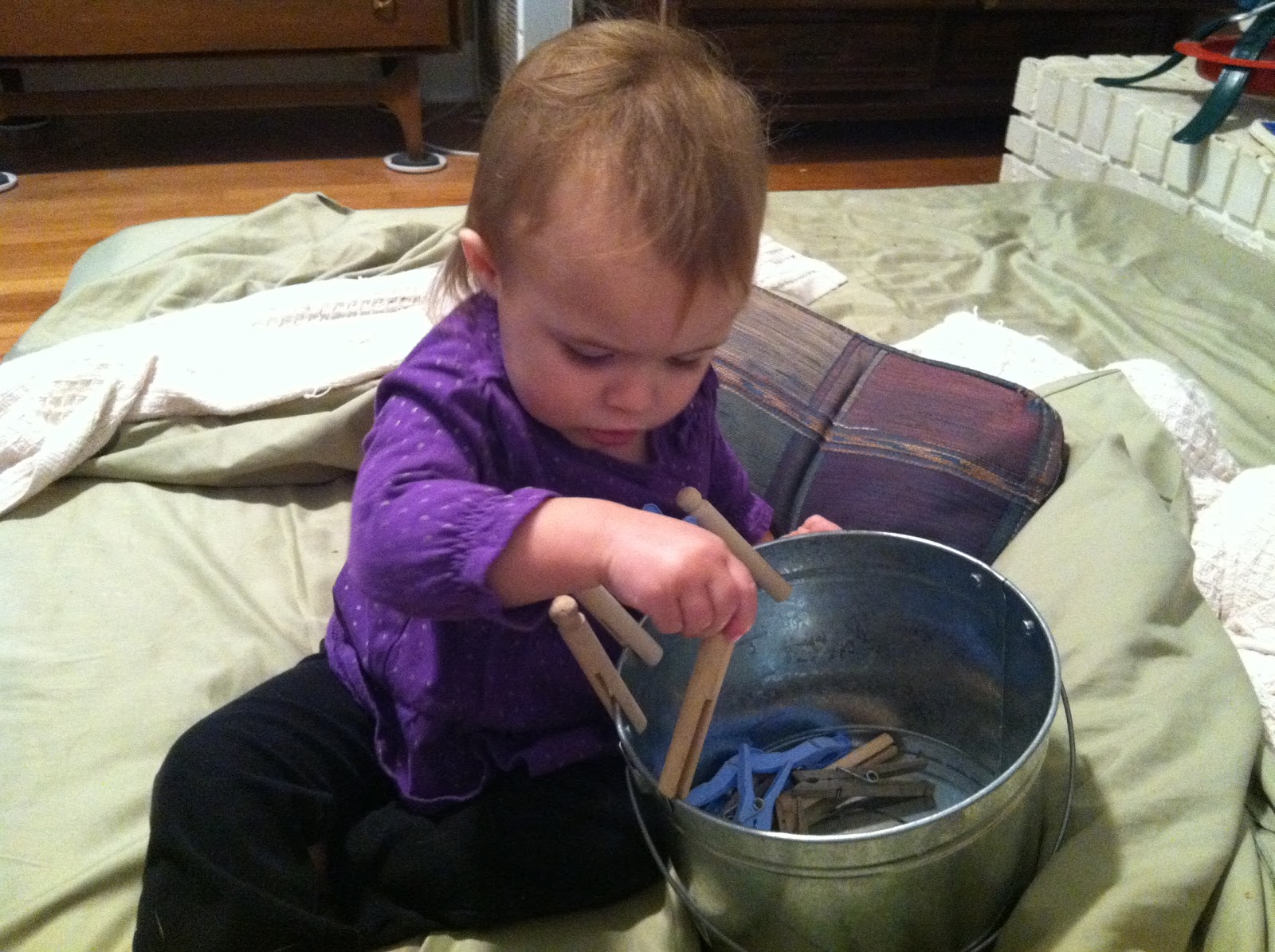
Vicki Jo has a few funny obsessions that have stuck with her for awhile now. She loves toothbrushes, and will frequently carry one around with her like a security blanket. She talks constantly about her "bucket," which is a small galvanized washtub we have in the backyard. She will play with the bucket for half an hour at a time, placing items in and taking them out. And clothespins. During the warm months, we hang laundry out a lot, so we have pins on the line in the yard. When we take out the trash or recycling or compost, she has to stop and gather several clothespins from the line.
When I saw this simple activity on a Montessori Album website, I knew it was the one for Vicki Jo! I've been continuing my rollout of new activities on her shelves, and wanted one that would draw her in and work her hands. It says ages 3-4, but she is able to do it pretty easily, although it takes her two hands to manipulate the springs on the pins. She is really developing her pincer, and her three-fingered grasp! Great practice for later writing and other fine motor.
I bought the smaller galvanized paint bucket from our local hardware store and pulled the clothespins off the line.
Tuesday, December 18, 2012
peeling fruit
Sometimes it's the littlest things. Vicki knows to go to the refrigerator, open it, and remove the clementine she wants to eat from the fruit bin. She has been fixated on them lately, wanting to eat three or four at a time. Without thinking about it, I had immediately been taking it from her, peeling it, and offering her pieces of the fruit.
The other day she showed me that she wants to be the one peeling it! I did not think she would be able to do this - in fact, I never even considered it. But she peeled it completely, from start to finish. Then she enjoyed a sweet reward for her labor!
It helps that clementines are very easy to peel. I love them, and they are one of the few "designer" fruits for which I will willingly pay extra when they are in stock during the winter.
Sometimes we just don't think about what our children are capable of doing, do we?
The other day she showed me that she wants to be the one peeling it! I did not think she would be able to do this - in fact, I never even considered it. But she peeled it completely, from start to finish. Then she enjoyed a sweet reward for her labor!
It helps that clementines are very easy to peel. I love them, and they are one of the few "designer" fruits for which I will willingly pay extra when they are in stock during the winter.
Sometimes we just don't think about what our children are capable of doing, do we?
Thursday, December 13, 2012
spooning beans
[This post submitted to Montessori Monday 1/21/13.]
In the midst of everything going - work, house renovation, new baby, traveling - I have been sorely remiss in rotating the materials on Vicki's shelves often enough. She was bored with most everything there, and it showed. Rather than finding purposeful activity, she would throw things around and be rough. So I schemed up a new plan. I wanted to include a wooden puzzle or two, a tonging activity, a spooning activity, a new doll (we have a box of dolls hiding around here somewhere), an activity with clothespins and a bucket, and some new art stuff in a separate area.
I started today with the spooning/scooping, because I already had everything we needed.
The setup: two bowls, a scoop or spoon (I tried two to see which she liked better), and dry beans. I keep the beans in a sealed jar until it's time to do the activity so it's not a hazard.
The activity: scoop them from one bowl to the other. This is helping develop the pronating wrist motions that will support writing and all the other fine movements we do with our hands.
You can see she preferred the smaller scoop. I should have known this! The closer to the child's size, the better they will be able to handle it. Also you can see that our ever-present helper lurks in the background.
It also became an impromptu screwing/unscrewing activity with the jar that held the beans.
And finally we had to get the jar lid involved in our scooping, too!
The verdict: she loved it. It absorbed her attention for at least twenty minutes, and when it was time to eat lunch, she wailed when we went to put it away. I shouldn't have interrupted her work cycle, but I presented this too late in the morning. She woke up from her nap pointing and begging to get it back out.
I should say that none of these ideas are original. I get almost all my Montessori activities for Vicki from Kylie at How We Montessori. Her son Otis is just a few weeks apart from Vicki, and she has the most innovative and gorgeous blog.
Wednesday, December 12, 2012
santa baby
We had our first encounter with a man dressed up as Santa.
Someone was just a bit terrified, which I naturally found hilarious (excuse the pale/tired/pregnant look). For the record, Santa here is a man we know very well - in fact, he is one of the contractors who helped put the addition on our house!
Santa is kind of a problem for me. Not this particular Santa, but the concept in general. At its heart, it's a good thing. Saint Nicholas was a real fourth-century man who had a generous spirit, worked many miracles, and liked to give gifts in secret.
But somewhere along the way, especially here in America, we've gotten all mixed up. Now Santa only gives presents to good boys and girls (except most of us don't mean that, and will still give Santa presents to our kids no matter what their behavior is, making it even more confusing as a parenting strategy), and his generosity is used as an incentive to good behavior. Elf on the Shelf is a sort of iteration of this narrative. We don't really have any shelves that work for that, since I want everything in our house to be accessible to Vicki. Plus the idea makes me shudder.
I also wonder about it from a Montessori perspective. Maria Montessori urged that children learn reality, and that we not reinforce myths and stories as truth, unless they actually are true. Children rely on trusted adults to help them sort fact from fiction for quite awhile. I found a good article on this topic that addressed the common accusation that Montessori is anti-imagination, anti-fantasy. The truth is that Montessori education insists that children learn reality first, so they can clearly distinguish what is fantasy from what is reality. And no matter how you slice it, telling your kids that someone comes into their house in the night and leaves presents under the tree just isn't the truth (and if it is the truth, I need to get signed up for this program!).
I never actually believed in Santa - not that I can remember. My folks did the charade, but I have older siblings, so most of these things were already ruined fo rme. I remember not being able to sleep one Christmas Eve, coming down and seeing my mom putting the Santa presents under the tree, and she got so angry with me. Angry that I had discovered the fantasy that she was trying to make into reality for me. I never forgot that.
But then part of me also says that one of problems of modernism was scientific reductionism. Myths could no longer hold any weight because they could not be proven. We lost something in our culture at that point. We lost faith in a single narrative to explain things, and thus launched postmodernism. We lost the trust that we had once had in the supernatural. Now we need sonograms to know that babies are really inside of us, we need proof that Jesus performed miracles in order to believe, and we need news from the source that we prefer because it caters to our reality (but that really is a kind of devolution back into myth: post-postmodernism?).
Vicki is getting old enough to know about Santa. I don't think that we will give her any presents from him, and I will wait until she asks questions about it and then try to frankly answer her. But she might just be that killjoy child who ruins it for all the other kids in her class - fair warning.
Someone was just a bit terrified, which I naturally found hilarious (excuse the pale/tired/pregnant look). For the record, Santa here is a man we know very well - in fact, he is one of the contractors who helped put the addition on our house!
Santa is kind of a problem for me. Not this particular Santa, but the concept in general. At its heart, it's a good thing. Saint Nicholas was a real fourth-century man who had a generous spirit, worked many miracles, and liked to give gifts in secret.
But somewhere along the way, especially here in America, we've gotten all mixed up. Now Santa only gives presents to good boys and girls (except most of us don't mean that, and will still give Santa presents to our kids no matter what their behavior is, making it even more confusing as a parenting strategy), and his generosity is used as an incentive to good behavior. Elf on the Shelf is a sort of iteration of this narrative. We don't really have any shelves that work for that, since I want everything in our house to be accessible to Vicki. Plus the idea makes me shudder.
I also wonder about it from a Montessori perspective. Maria Montessori urged that children learn reality, and that we not reinforce myths and stories as truth, unless they actually are true. Children rely on trusted adults to help them sort fact from fiction for quite awhile. I found a good article on this topic that addressed the common accusation that Montessori is anti-imagination, anti-fantasy. The truth is that Montessori education insists that children learn reality first, so they can clearly distinguish what is fantasy from what is reality. And no matter how you slice it, telling your kids that someone comes into their house in the night and leaves presents under the tree just isn't the truth (and if it is the truth, I need to get signed up for this program!).
I never actually believed in Santa - not that I can remember. My folks did the charade, but I have older siblings, so most of these things were already ruined fo rme. I remember not being able to sleep one Christmas Eve, coming down and seeing my mom putting the Santa presents under the tree, and she got so angry with me. Angry that I had discovered the fantasy that she was trying to make into reality for me. I never forgot that.
But then part of me also says that one of problems of modernism was scientific reductionism. Myths could no longer hold any weight because they could not be proven. We lost something in our culture at that point. We lost faith in a single narrative to explain things, and thus launched postmodernism. We lost the trust that we had once had in the supernatural. Now we need sonograms to know that babies are really inside of us, we need proof that Jesus performed miracles in order to believe, and we need news from the source that we prefer because it caters to our reality (but that really is a kind of devolution back into myth: post-postmodernism?).
Vicki is getting old enough to know about Santa. I don't think that we will give her any presents from him, and I will wait until she asks questions about it and then try to frankly answer her. But she might just be that killjoy child who ruins it for all the other kids in her class - fair warning.
Thursday, December 6, 2012
avoiding ultrasound
Jeff and I have made an intentional decision to avoid any and all unnecessary ultrasound in this pregnancy. I have a few reasons - it's not just for the sake of being difficult or countercultural, I promise! I'm still deciding whether I think "ultrasound," for me, includes using the doppler to detect the heart rate of the baby. Of course, a doppler is a kind of ultrasound. But it's very brief (usually 15 seconds or less), and not as invasive as scans. We have had two doppler scans thus far, but I hope to switch to a fetoscope within the month.
Here are my reasons:
1) I had multiple sonograms in my first pregnancy, and every time they predicted a dire condition that proved not to be a problem.
I had one at seven weeks because my cycle had been short and they wanted to more accurately predict my due date. I was diagnosed with a low-lying placenta, and given all sorts of special instructions. What I didn't know at the time, because of my first-time mom naivete, was that a lot of placentas are low at that point, because they tend to grow up and out during the course of pregnancy. At seven weeks, there is not a lot of real estate in the uterus for the placenta. By the next ultrasound, the problem was gone. But I had stressed and worried and followed certain procedures for thirteen weeks, all of which proved to be unnecessary. Plus, the danger of a low-lying placenta is only in labor. It is a true reason for a c-section, but an ultrasound at seven weeks could not in any way predict where the placenta would be at the time of labor.
I had the standard twenty-week scan to check the chambers of the heart, sex of the baby, and positioning of organs and placenta. At this one, the placenta was fine, but Vicki would not get into the right position to see her heart, and "they" became convinced that she had a heart deformity. Again, if this were true, it would be a cause for special procedures in labor and immediately following (usually a NICU stay). I was ordered to come back at 28 weeks for another scan.
At the 28-week ultrasound, the heart looked great, but Vicki was breech and this caused numerous conversations and much worry and strife for me. Again, I should have been educated enough to know that she had twelve whole weeks to flip. A 28-week scan cannot predict breech birth! Naturally, she was head-down within four or five weeks.
By 36 or 37 weeks, my blood pressure was creeping up (no wonder, with all this unnecessary stress!), so I had to start having all manner of scans, non-stress tests, etc. Each one worried me more and more. Baby was small - no wait, baby was huge (baby came out perfectly average at 7 lb 1 oz). Fluid was low. Due date was wrong. Actually, original due date was right. Late pregnancy ultrasounds are just notoriously full of errors that impact birth.
I just don't want the stress this time. I don't want the worry. I want to worry if I have a real reason to worry, not an invented one that doesn't prove to be an actual problem. I am an anxious enough personality that "taking it easy" just doesn't come naturally when I feel that my baby might be messed up.
2) Routine ultrasounds - and especially "vanity" ultrasounds just for the sake of seeing the baby - have not been proven safe! Just because they are common practice for standard obstetric care in this country does not mean they are safe. This is just another one of the issues in our American model - we don't practice evidence-based medicine! Here is a great video clip from Mama Natural about the concerns her care providers presented about the safety of routine ultrasound.
3) The womb is dark, calm, fluid, and full of rhythmic body noise for a reason. I have to believe that we were designed that way. Every time I put waves in there, I disturb that environment. There are videos and stories of women whose babies turn away from the ultrasound wand. Or babies that get really active when those waves enter their home. We think it's cute on the screen, but it's not normal for them!
Here's a great blog by a Montessori mama on why she chose to forgo ultrasound and doppler, and how she trusts Nature and her child to form in the way that is proper.
I also read a beautiful story of homebirth in Holland. The American mother was surprised by the hands-off approach of her Dutch midwives, who gently insisted that healthy pregnancy and birth was her job, not theirs. When she asked why no ultrasound, I just loved their answer:
I think that sums up my thoughts on it, too.
I have requested that our midwives use a fetoscope, which is a special kind of stethoscope for pregnant bellies. It's almost a lost art. A fetoscope cannot be reliably used to heart fetal heart tones until 20 weeks or later, so we have not yet started using it.
The main issue was practical, for me. Jeff and I wanted to wait until we heard a heartbeat to tell all our friends and family about the new baby. I wanted some kind of proof that there was truly a little human in there. Like the very clear signs that my body was giving me weren't enough! I needed something "scientific." We did use a doppler to hear the heartbeat at 12 weeks, so I could feel comfortable in announcing our pregnancy.
Our midwives left the decision to me and Jeff, but did recommend one ultrasound at 20-22 weeks, to see if development was occurring appropriately, and to check the sex of baby if we desired. We have decided to have this one scan, which will be in ten days or so.
Let me emphasize, before closing, that I don't think ultrasound is a bad idea for everyone, all the time. If your body is giving you indications that you have an issue, or if you are concerned about the likelihood of conditions that may come up because of your age or risk factors, it's probably a good idea to go ahead and get one or more. Do a cost/benefit analysis for yourself. But, just like the cesarean section, which is truly life-saving when really necessary, we have confused what is good in rare pregnancies with what should happen in every pregnancy.
Here are my reasons:
1) I had multiple sonograms in my first pregnancy, and every time they predicted a dire condition that proved not to be a problem.
I had one at seven weeks because my cycle had been short and they wanted to more accurately predict my due date. I was diagnosed with a low-lying placenta, and given all sorts of special instructions. What I didn't know at the time, because of my first-time mom naivete, was that a lot of placentas are low at that point, because they tend to grow up and out during the course of pregnancy. At seven weeks, there is not a lot of real estate in the uterus for the placenta. By the next ultrasound, the problem was gone. But I had stressed and worried and followed certain procedures for thirteen weeks, all of which proved to be unnecessary. Plus, the danger of a low-lying placenta is only in labor. It is a true reason for a c-section, but an ultrasound at seven weeks could not in any way predict where the placenta would be at the time of labor.
I had the standard twenty-week scan to check the chambers of the heart, sex of the baby, and positioning of organs and placenta. At this one, the placenta was fine, but Vicki would not get into the right position to see her heart, and "they" became convinced that she had a heart deformity. Again, if this were true, it would be a cause for special procedures in labor and immediately following (usually a NICU stay). I was ordered to come back at 28 weeks for another scan.
At the 28-week ultrasound, the heart looked great, but Vicki was breech and this caused numerous conversations and much worry and strife for me. Again, I should have been educated enough to know that she had twelve whole weeks to flip. A 28-week scan cannot predict breech birth! Naturally, she was head-down within four or five weeks.
By 36 or 37 weeks, my blood pressure was creeping up (no wonder, with all this unnecessary stress!), so I had to start having all manner of scans, non-stress tests, etc. Each one worried me more and more. Baby was small - no wait, baby was huge (baby came out perfectly average at 7 lb 1 oz). Fluid was low. Due date was wrong. Actually, original due date was right. Late pregnancy ultrasounds are just notoriously full of errors that impact birth.
I just don't want the stress this time. I don't want the worry. I want to worry if I have a real reason to worry, not an invented one that doesn't prove to be an actual problem. I am an anxious enough personality that "taking it easy" just doesn't come naturally when I feel that my baby might be messed up.
2) Routine ultrasounds - and especially "vanity" ultrasounds just for the sake of seeing the baby - have not been proven safe! Just because they are common practice for standard obstetric care in this country does not mean they are safe. This is just another one of the issues in our American model - we don't practice evidence-based medicine! Here is a great video clip from Mama Natural about the concerns her care providers presented about the safety of routine ultrasound.
3) The womb is dark, calm, fluid, and full of rhythmic body noise for a reason. I have to believe that we were designed that way. Every time I put waves in there, I disturb that environment. There are videos and stories of women whose babies turn away from the ultrasound wand. Or babies that get really active when those waves enter their home. We think it's cute on the screen, but it's not normal for them!
Here's a great blog by a Montessori mama on why she chose to forgo ultrasound and doppler, and how she trusts Nature and her child to form in the way that is proper.
I also read a beautiful story of homebirth in Holland. The American mother was surprised by the hands-off approach of her Dutch midwives, who gently insisted that healthy pregnancy and birth was her job, not theirs. When she asked why no ultrasound, I just loved their answer:
"We don't open doors that don't need to be opened."
I think that sums up my thoughts on it, too.
I have requested that our midwives use a fetoscope, which is a special kind of stethoscope for pregnant bellies. It's almost a lost art. A fetoscope cannot be reliably used to heart fetal heart tones until 20 weeks or later, so we have not yet started using it.
The main issue was practical, for me. Jeff and I wanted to wait until we heard a heartbeat to tell all our friends and family about the new baby. I wanted some kind of proof that there was truly a little human in there. Like the very clear signs that my body was giving me weren't enough! I needed something "scientific." We did use a doppler to hear the heartbeat at 12 weeks, so I could feel comfortable in announcing our pregnancy.
Our midwives left the decision to me and Jeff, but did recommend one ultrasound at 20-22 weeks, to see if development was occurring appropriately, and to check the sex of baby if we desired. We have decided to have this one scan, which will be in ten days or so.
Let me emphasize, before closing, that I don't think ultrasound is a bad idea for everyone, all the time. If your body is giving you indications that you have an issue, or if you are concerned about the likelihood of conditions that may come up because of your age or risk factors, it's probably a good idea to go ahead and get one or more. Do a cost/benefit analysis for yourself. But, just like the cesarean section, which is truly life-saving when really necessary, we have confused what is good in rare pregnancies with what should happen in every pregnancy.
Wednesday, November 14, 2012
what makes it montessori?
I was inspired to share these thoughts by Kylie's most recent post at How We Montessori. One of the things I'm so excited about in our neighborhood is the Montessori school. It is a primary class only, meaning they accept the traditional Children's House ages of 2 1/2 - 6. Children who continue all the way through would then typically start their new schools in first grade.
Knowing how popular this school is, how small the enrollment space is, and how much I love Montessori education, I scheduled a tour at the end of summer to check out Montessori East. What I found there checked all the boxes for me: AMI trained directress and head teachers, authentic materials, totally mixed-aged classrooms, and long periods for uninterrupted work cycles with the children free to choose their own work.
Some of the materials I saw there that clued me in to authenticity:
I went right ahead and filled out the application and gave our application fee. I do so hope that there will be room for Vicki next October when she is the proper age. Also, it gives me incentive to get her using the toilet, since a requirement is that all children must be fully trained toilet educated.
In our public school system, there are also two more options. These are magnet schools with Montessori as their magnet focus. They accept children in the Fall who are aged three, and then go up through 4th grade. They do retain mixed-age classrooms. The obviously huge benefit is that they are essentially free (there is a small enrollment fee, like $50) - paid for by our taxes.
But I need to visit and see how much they are able to retain the Montessori focus while they must also adhere to state standards and annual testing. I need to find out about the teachers, their training, and how much they incorporate Montessori.
The big downside is that both of these schools (Stanford Montessori Design Center and Hull-Jackson Montessori Magnet) are outside of our "cluster," which means I have to apply by lottery and I am pretty far down the list to start with. Nashville's school lottery is fairly confusing, but the bottom line makes sense: the closer you live, the more priority you get. So, the "geographic preference zone" is the closest. This is what we would call the "neighborhood school" - you live close enough to walk. We are actually in the GPZ for an amazing elementary school, but it's not Montessori at all. The next circle out is the "cluster" - this means which high school you are zoned for. Everyone that feeds that high school is in the same cluster. After that is a preference for siblings. If you already have one child at a school, you get some preference to have your other children there. Next, a classification for parents who work nearby - makes sense to bring your child to a school near where you work. And then the final concentric circle, "county-wide." Essentially, everyone else. And that's where we are for these two schools. There's no downside to trying your luck in the lottery, but I'm not holding my breath. I checked the results from last year, and only a small fraction of the county-wide families got into either of these schools.
The other issue I bemoan with any of these Montessori options - public or private - is that I would pull Vicki for Kindergarten. The Montessori environment greatly benefits from having children from the full age spectrum (2 1/2 - 6), because the older children naturally serve as leaders and mentors. They really ask that you keep your child there for the full term. And I totally get that.
But there's that other school I told you about! Lockeland Design Center. This school is literally three blocks away, has some of the best testing scores in the city, gets rave reviews from parents, and is a strong neighborhood and community connection. I want in. Problem is, there are so many young families in our neighborhood that even kids who live in the GPZ didn't make it in last year!! That is very unusual. That means that all those other concentric circles I described above got zero consideration. I checked out their lottery results from last year too, and your best chance by far is to apply for your child to start in Kindergarten. Every year after that, there are fewer and fewer spots that open up each year. I want the best chance to get into this school, so that would mean pulling Vicki from her Montessori room before the full cycle is up. Boo.
What to do? Still not sure. I need to tour those other two Montessori magnets, see what I think, then wait and see what happens next October with Montessori East. We also need to figure out how to afford it . . . double boo.
Knowing how popular this school is, how small the enrollment space is, and how much I love Montessori education, I scheduled a tour at the end of summer to check out Montessori East. What I found there checked all the boxes for me: AMI trained directress and head teachers, authentic materials, totally mixed-aged classrooms, and long periods for uninterrupted work cycles with the children free to choose their own work.
Some of the materials I saw there that clued me in to authenticity:
![]() |
| The color tablets. |
![]() |
| The knobbed cylinders. |
![]() |
| The pink tower. |
In our public school system, there are also two more options. These are magnet schools with Montessori as their magnet focus. They accept children in the Fall who are aged three, and then go up through 4th grade. They do retain mixed-age classrooms. The obviously huge benefit is that they are essentially free (there is a small enrollment fee, like $50) - paid for by our taxes.
But I need to visit and see how much they are able to retain the Montessori focus while they must also adhere to state standards and annual testing. I need to find out about the teachers, their training, and how much they incorporate Montessori.
The big downside is that both of these schools (Stanford Montessori Design Center and Hull-Jackson Montessori Magnet) are outside of our "cluster," which means I have to apply by lottery and I am pretty far down the list to start with. Nashville's school lottery is fairly confusing, but the bottom line makes sense: the closer you live, the more priority you get. So, the "geographic preference zone" is the closest. This is what we would call the "neighborhood school" - you live close enough to walk. We are actually in the GPZ for an amazing elementary school, but it's not Montessori at all. The next circle out is the "cluster" - this means which high school you are zoned for. Everyone that feeds that high school is in the same cluster. After that is a preference for siblings. If you already have one child at a school, you get some preference to have your other children there. Next, a classification for parents who work nearby - makes sense to bring your child to a school near where you work. And then the final concentric circle, "county-wide." Essentially, everyone else. And that's where we are for these two schools. There's no downside to trying your luck in the lottery, but I'm not holding my breath. I checked the results from last year, and only a small fraction of the county-wide families got into either of these schools.
The other issue I bemoan with any of these Montessori options - public or private - is that I would pull Vicki for Kindergarten. The Montessori environment greatly benefits from having children from the full age spectrum (2 1/2 - 6), because the older children naturally serve as leaders and mentors. They really ask that you keep your child there for the full term. And I totally get that.
But there's that other school I told you about! Lockeland Design Center. This school is literally three blocks away, has some of the best testing scores in the city, gets rave reviews from parents, and is a strong neighborhood and community connection. I want in. Problem is, there are so many young families in our neighborhood that even kids who live in the GPZ didn't make it in last year!! That is very unusual. That means that all those other concentric circles I described above got zero consideration. I checked out their lottery results from last year too, and your best chance by far is to apply for your child to start in Kindergarten. Every year after that, there are fewer and fewer spots that open up each year. I want the best chance to get into this school, so that would mean pulling Vicki from her Montessori room before the full cycle is up. Boo.
What to do? Still not sure. I need to tour those other two Montessori magnets, see what I think, then wait and see what happens next October with Montessori East. We also need to figure out how to afford it . . . double boo.
Tuesday, October 2, 2012
independence and limits
My mother and father grew up in the same very small town. My brother, sister and I grew up in a small university city. We lived in a residential neighborhood that had a shopping corridor about three or four blocks away. There are so many things I wish I could ask my mother now (of course). But one of the major topics I wish I could know more about is how she decided to give us so much freedom. Was it of necessity (as a single parent)? Was it of naivete (not thinking bad things could happen)? Did she even think that much about it, or was it just the way the world worked for her?
My mother had a sort of slogan about this: "You can have as much freedom as you show me you can handle." Basically this meant: do well in school, don't get pregnant, don't get arrested, be a good person. Do whatever you want besides.
I also have to consider my perspective. I was the third child, born ten years after my oldest sibling. Mom had to have been considerably more relaxed, less bent on the details, and quite a bit more tired by the time I was old enough to start tearing up the town.
All I know is, I spent summers riding my bike and mowing the lawn, walking to Walgreen's to buy candy with my change, walking to the high school across the street to play tennis at the courts, and riding my bike to the swimming pool (a cool two miles from home). During the school year, I walked to school with a group of other kids (no adults), walked to church (by the swimming pool), and walked to my piano teacher's house for lessons. It was awesome.
I came across this super-thought-provoking article on NPR today.
It is a fascinating read. The author posits, as I think most of us would agree, that children today have much less freedom to roam, unsupervised and unscheduled. He even has a very cool graphic showing four generations of a family, all at eight years old, in Sheffield, England. The great-grandfather was allowed to go six miles from home to the lake and fish. The grandfather was allowed several miles to go play in the woods. The mother was allowed a half-mile or so to the pool. The son can walk 300 yards to the end of his street.
I don't usually do this, but I allowed myself to read all seventy-odd comments on the article to get a sense of how people feel about this. Many people said, "I was raised with a lot of freedom, but I'm scared to give my kids that level of access to the world because it's more dangerous now." Population density, higher crime, faster and more traffic, neighbors not being as knowledgeable about one another, fewer sidewalks, and the hypervigilant, sensationalizing media were all referenced.
A few commenters had theories I thought were simply genius. One was that we don't accept child casualty as a fact of life anymore. I thought about that for awhile. Both of my grandfathers lost one of their siblings in childhood, to disease or accident. Their parents had large families of six and seven. One commenter remarked that he had a "free range" childhood, and he knew one child who suffocated in an old refrigerator, one who drowned in an access pond, and one who was hit by a car. These incidents seemed like part of what life held for some families at that point. Certainly none of the families were prosecuted by the state for negligence or abuse.
Another theory was that smaller family size and later age of childbearing in developed countries have made a high-stakes game of childhood, where there is no "screwing up" with your kids. You can't have five and expect one to end up alcoholic or destitute. That's just not how it works anymore. And parents feel so unbearably responsible for their children's futures.
Will I allow Vicki Jo and our other, future children to roam freely in our neighborhood? Gosh. I hope so. I don't know.
I do know that the free and open times I had by myself as a child were a huge benefit to an independent life. I took off for college 1200 miles away with very little trepidation. I remember when I set off on my first thousand-mile solo road trip, no smart phone, just an atlas and the knowledge that we have a fantastic interstate system that would take me where I needed to go. I learned how to fend for myself and feel secure that I could find my way home. Was that worth the risk of injury, bullying, and abduction? With 20/20 hindsight, yes.
What will you all do with your children? Allow them to roam, or keep them within sight?
Wednesday, September 5, 2012
wee helper
Wednesday is typically my day off. I go in for our Wednesday evening supper and program at church because I run it, but I get to spend the day with the dog and the little one. Today's been a good one, so far. We:
-Had an electrician out to look at the oven. Computer busted, cost: $500. Kill me. Pretty please, home warranty, cover this?
-Prepped for Godly Play sessions that happen Wednesday evenings. Today, I'm working on the Circle of the Church Year wall hanging! More to come on this later.
-Helped Jeff/dad celebrate his 29th birthday! Happy birthday bartender!
-Tried unsuccessfully to take a morning nap (why, oh why, must we lose two naps and go to one!?).
-Toyed with Google Analytics.
-Tried out Vicki's new underpants for the morning! (Big girl.)
-Finished up some laundry:
My assistant loves to help with laundry. She uses her walker wagon to collect her dirty clothes and bring them to the washer, then take the clean ones from the dryer back to her room for folding. Jeff just commented this morning that he hopes Vicki continues to love chores this much for the rest of her life! She can't get enough of washing, wiping, folding, collecting, sorting, loading and unloading the dishwasher, and feeding the dog.
Happy Wednesday to all! Oh, and guess what I'm getting the bartender for his birthday?? That's right - a tattoo of a wedding band! Now he can never get rid of me!
-Had an electrician out to look at the oven. Computer busted, cost: $500. Kill me. Pretty please, home warranty, cover this?
-Prepped for Godly Play sessions that happen Wednesday evenings. Today, I'm working on the Circle of the Church Year wall hanging! More to come on this later.
-Helped Jeff/dad celebrate his 29th birthday! Happy birthday bartender!
-Tried unsuccessfully to take a morning nap (why, oh why, must we lose two naps and go to one!?).
-Toyed with Google Analytics.
-Tried out Vicki's new underpants for the morning! (Big girl.)
-Finished up some laundry:
My assistant loves to help with laundry. She uses her walker wagon to collect her dirty clothes and bring them to the washer, then take the clean ones from the dryer back to her room for folding. Jeff just commented this morning that he hopes Vicki continues to love chores this much for the rest of her life! She can't get enough of washing, wiping, folding, collecting, sorting, loading and unloading the dishwasher, and feeding the dog.
Happy Wednesday to all! Oh, and guess what I'm getting the bartender for his birthday?? That's right - a tattoo of a wedding band! Now he can never get rid of me!
Sunday, September 2, 2012
practical life: care of self
Vicki Jo has entered a phase of wanting to dress herself! She is also giving very clear signs about when she has to use the bathroom. As in: saying "poo" as she does it, and crawling over to the corner of her bed last night while I was dressing her after the bath, turning her back to me, standing up, and peeing all over the bed. Sigh.
I love how in the photos above she knows that her foot is supposed to somehow come out the other end of the pant-leg, but she just can't quite figure out how to make it happen. She's working hard! She loves digging through her dirty laundry (which we keep in the small wicker basket in the periphery of the photos) and finding things to put on.
All of this is so strange to me because she is still not walking (at seventeen months today!). I'm hesitant to start toilet learning when she is unable to pull her own pants down and walk to the toilet, but she seems to be telling me that it's time to think about it.
Friday, August 31, 2012
good morning starshine
This photo pretty well sums up mornings around here: chaotic. I usually try to get Vicki Jo to focus on an activity that really seizes her concentration, so I can move around quickly and get both of us ready and make breakfast.
This morning: spooning ice! She loved it. I try not to use this much plastic in our work, but with the water I didn't want to use a wooden tray. I just popped a few ice cubes out of the blue ice tray onto the purple plastic tray, showed her how to use a spoon to transfer them to the white pitcher, and let her have at it! She loves "poons" right now. Toss up for favorite word between 'poon, shoe, and phone. (She's also really into toothbrushes. Goofball.)
Friday, August 24, 2012
concentration
This is the current favorite activity. Take the wipes out of the container, put the wipes into the container. She did this for no less that 45 minutes this morning. I tried my hardest not to interrupt her concentration or the flow of her work.
Vicki Jo has shown an interest in taking the wipes out of their container (when we are using disposable wipes, rather than our homemade ones - we are about 50/50) for a long time. Probably a year? It used to drive me crazy because she was lunging for the wipes the second I tried to change her.
But then, one day, I left her alone in her room with the wipes container. I figured it would be a huge mess, but oh well - she would be entertained for awhile. I was surprised to find that, when I left her to finish the whole process, she took them out and put them back in five or six times, but left the project completely neat and put away.
Thanks, Montessori! You have taught me to value what my child is interested in, try to observe her, and then leave her alone.
(P.S. This is a "keeping it real" photo! Messy bed, shoes everywhere, a lint roller (?), and a socket with no protector. She has figured out how to get socket protectors out. And unplugging stuff? Forget it. She's all over that.)
Wednesday, August 15, 2012
little mind readers
[This post submitted for Living Montessori Now's "Montessori Monday.]
The newsletter from Michael Olaf arrived the other day! Whenever updates come from them, all else is postponed until I get through scouring it. I wonder who Michael Olaf is? He must have loved Montessori an awful lot!
This latest newsletter was all about Practical Life. To me, practical life is the genius of Montessori. It is a way of thinking more than anything else. It's an attitude that says My child needs valuable work. My child doesn't need special "baby" or "child" activities. My child wants to be involved in whatever I view as important. My child needs appropriate tools and environments for participating in the life of our family.
When I first learned about this area of Montessori education, I immediately thought of the roles my mother let me have in our household from a very young age. I benefited from being the youngest because she was much more relaxed about what I could do. For instance, one of my duties was to rise early while it was still cool in the summer, put gasoline in the lawnmower, and mow the front and back lawns myself. I did each of these tasks without supervision from the age of about 10. Rather than viewing it as a burden, I loved mowing because I was given so much freedom and responsibility to do something that really mattered. Real work. I remember folding laundry with Mom from a very young age - maybe 2 or 3. Again, I loved it. I still love folding laundry. Weird, I know.
Classic practical life exercises like cutting fruit and vegetables, dusting plants, sweeping, washing dishes, and so on, are typically geared toward children starting at around 15 months. I think a prerequisite for most of them is the ability to walk. So, we are a bit behind there. But Vicki has been helping me load and empty the dishwasher, load and unload the dryer (and transport clothes to be folded in her walker wagon to the place in the living room where we fold!), and I've recently noticed her begin to show an interest in wiping the floor and other surfaces with a dishcloth, beginning to lay things out flat and try to fold them, and also wanting to wipe her nose, mouth, and diaper area with cotton wipes (I suppose that is more Care of Self than Practical Life). She also loves transferring and pouring items and liquids.
One of the later paragraphs in the newsletter caught my eye. It wasn't so much about Practical Life as it was about emotional expression. It reminded me of something I learned about Vicki Jo from her youngest days. I remember thinking that she could smell fear or hesitation. She could tell when I wasn't wholehearted about something. Here is the quote:
"Children also read the adult's mind and emotion and will carry out research to find out exactly what the parent is trying to communicate when they give double messages—for example when an angry parent is trying to appear cheerful.
A child needs to know that it is all right to feel and express anger and frustration. He needs models to learn how—walking, scrubbing a floor, hitting a pillow or pounding clay—and not hitting another person (spanking included). If an adult goes for a walk or pounds clay, so will the child. If the adult hits the child, the child learns that it is okay to hit to express emotion."
Wow! I was spanked a few times, and honestly, I remember doing really horrid things and really deserving it. It didn't make me fear my mother or make me more prone to hitting others. I don't think we will spank Vicki, and I love these suggestions for showing children how to resolve angry emotions. I love the phrase about how the child will "carry out research" if they sense a double message is present. It is so true. You can't hide anything from these little clairvoyants. Realizing this makes me redouble my efforts to live authentically and show Vicki Jo that real, practical life is full of joy and beauty, but also frustration and mistakes.
The newsletter from Michael Olaf arrived the other day! Whenever updates come from them, all else is postponed until I get through scouring it. I wonder who Michael Olaf is? He must have loved Montessori an awful lot!
This latest newsletter was all about Practical Life. To me, practical life is the genius of Montessori. It is a way of thinking more than anything else. It's an attitude that says My child needs valuable work. My child doesn't need special "baby" or "child" activities. My child wants to be involved in whatever I view as important. My child needs appropriate tools and environments for participating in the life of our family.
When I first learned about this area of Montessori education, I immediately thought of the roles my mother let me have in our household from a very young age. I benefited from being the youngest because she was much more relaxed about what I could do. For instance, one of my duties was to rise early while it was still cool in the summer, put gasoline in the lawnmower, and mow the front and back lawns myself. I did each of these tasks without supervision from the age of about 10. Rather than viewing it as a burden, I loved mowing because I was given so much freedom and responsibility to do something that really mattered. Real work. I remember folding laundry with Mom from a very young age - maybe 2 or 3. Again, I loved it. I still love folding laundry. Weird, I know.
Classic practical life exercises like cutting fruit and vegetables, dusting plants, sweeping, washing dishes, and so on, are typically geared toward children starting at around 15 months. I think a prerequisite for most of them is the ability to walk. So, we are a bit behind there. But Vicki has been helping me load and empty the dishwasher, load and unload the dryer (and transport clothes to be folded in her walker wagon to the place in the living room where we fold!), and I've recently noticed her begin to show an interest in wiping the floor and other surfaces with a dishcloth, beginning to lay things out flat and try to fold them, and also wanting to wipe her nose, mouth, and diaper area with cotton wipes (I suppose that is more Care of Self than Practical Life). She also loves transferring and pouring items and liquids.
One of the later paragraphs in the newsletter caught my eye. It wasn't so much about Practical Life as it was about emotional expression. It reminded me of something I learned about Vicki Jo from her youngest days. I remember thinking that she could smell fear or hesitation. She could tell when I wasn't wholehearted about something. Here is the quote:
"Children also read the adult's mind and emotion and will carry out research to find out exactly what the parent is trying to communicate when they give double messages—for example when an angry parent is trying to appear cheerful.
A child needs to know that it is all right to feel and express anger and frustration. He needs models to learn how—walking, scrubbing a floor, hitting a pillow or pounding clay—and not hitting another person (spanking included). If an adult goes for a walk or pounds clay, so will the child. If the adult hits the child, the child learns that it is okay to hit to express emotion."
Wow! I was spanked a few times, and honestly, I remember doing really horrid things and really deserving it. It didn't make me fear my mother or make me more prone to hitting others. I don't think we will spank Vicki, and I love these suggestions for showing children how to resolve angry emotions. I love the phrase about how the child will "carry out research" if they sense a double message is present. It is so true. You can't hide anything from these little clairvoyants. Realizing this makes me redouble my efforts to live authentically and show Vicki Jo that real, practical life is full of joy and beauty, but also frustration and mistakes.
Thursday, July 26, 2012
something new and thrilling
One part of my ministry in my new appointment includes children and their families. I have worked in a classroom before, and also been a children's pastor, so this was nothing too new or daunting for me. I love being around children. Their frankness and playfulness delight me, and sometimes I feel it is much easier to speak and be with them than it is with adults.
Since Vicki Jo's birth, I have also been drawn into the Montessori method of creating environments and approaching development.
I knew, from some research, that Maria Montessori had developed a spiritual formation approach called the Catechesis of the Good Shepherd. Her collaborator, Gianna Gobbi (for whom the fabled Gobbi mobile is named), is largely responsible for organizing and cataloguing this approach, along with Sophia Cavalletti. Here is a good webpage about the genealogy of this amazing way to allow children to discover God inside them.
Gobbi, Cavaletti, and Montessori were, of course, Roman Catholics. That is not my particular tradition, and so some of the details of the curriculum do not make sense in my context. What to do? How to incorporate the Montessori ideals of beauty, learning first through the hand, and having meaningful work?
And then I found Godly Play. Dreamed up by an Episcopalian priest named Jerome Berryman (a Kansan!), this approach modifies and builds on Catechesis of the Good Shepherd to make sense in a Protestant environment. And trust me, dreamy it is.
This is a shelf of materials for telling Biblical stories, wondering aloud together, and working to develop a language about the God of grace that already resides in each child.
I am deep into reading his work and preparing to slowly implement this method with the children in my care. We will do our wondering and working on Wednesday evenings together. Expect regular updates as I figure out what I'm doing, collect materials (like everything Montessori, Godly Play is heavy on specific items), and collaborate with children.
I will leave you with this quote from Teaching Godly Play: "For example, when children prepared for their first communion they harvested the wheat and processed through the school, carrying it tied in small bundles with ribbons. They then ground the flour and stamped the rolled-out dough they had made with a personally chosen Christian symbol. Finally they baked their personal communion hosts to be consumed on the grand day when they first participated in the Holy Mysteries." (p. 24, describing how Montessori helped children prepare for their first communion at her school in Barcelona).
Since Vicki Jo's birth, I have also been drawn into the Montessori method of creating environments and approaching development.
I knew, from some research, that Maria Montessori had developed a spiritual formation approach called the Catechesis of the Good Shepherd. Her collaborator, Gianna Gobbi (for whom the fabled Gobbi mobile is named), is largely responsible for organizing and cataloguing this approach, along with Sophia Cavalletti. Here is a good webpage about the genealogy of this amazing way to allow children to discover God inside them.
Gobbi, Cavaletti, and Montessori were, of course, Roman Catholics. That is not my particular tradition, and so some of the details of the curriculum do not make sense in my context. What to do? How to incorporate the Montessori ideals of beauty, learning first through the hand, and having meaningful work?
And then I found Godly Play. Dreamed up by an Episcopalian priest named Jerome Berryman (a Kansan!), this approach modifies and builds on Catechesis of the Good Shepherd to make sense in a Protestant environment. And trust me, dreamy it is.
This is a shelf of materials for telling Biblical stories, wondering aloud together, and working to develop a language about the God of grace that already resides in each child.
I am deep into reading his work and preparing to slowly implement this method with the children in my care. We will do our wondering and working on Wednesday evenings together. Expect regular updates as I figure out what I'm doing, collect materials (like everything Montessori, Godly Play is heavy on specific items), and collaborate with children.
I will leave you with this quote from Teaching Godly Play: "For example, when children prepared for their first communion they harvested the wheat and processed through the school, carrying it tied in small bundles with ribbons. They then ground the flour and stamped the rolled-out dough they had made with a personally chosen Christian symbol. Finally they baked their personal communion hosts to be consumed on the grand day when they first participated in the Holy Mysteries." (p. 24, describing how Montessori helped children prepare for their first communion at her school in Barcelona).
Tuesday, July 17, 2012
the low shelf
[This post submitted for Montessori Monday at Living Montessori Now.]
At long last, a low shelf!
I feel so ashamed that I would call myself a Montessori enthusiast and yet, Vicki Jo has not had her own low shelf up until now. Our last living space was not ideal for our life together, and I didn't want to buy more furniture only to move it. We are finally moved, she has her own room, and the three necessities to me were: a floor bed, a low shelf (or two!), and a low table and chair. We have the first, we now have the second, and we will soon have the third.
Rather than buy one, Jeff made one for us and I painted it. It truly could not have been easier. I read in Michael Olaf that the shelf was to be four feet in length, 12.5 inches tall, and 11 inches deep. I cheated a little so that we could use one board, and decided that it would be a simple 4'x1'x1' rectangle. Jeff bought one 12' 1x12, so that we could have a little room for error. He sawed it into the proper lengths and screwed it together using a few L-brackets for added strength and stability.
I covered it with some leftover brown paint. If we wanted to be extra-fancy, we could have sanded and stained it. The list price in Michael Olaf is $185. We made this shelf for about $25 - the board cost $22, and then whatever else for screws, brackets and paint.
I'm trying to keep a variety of interesting work on here.
Clockwise from top left:
*Napkin and felt square to practice folding
*One rhythm stick (lost its partner!)
*Object permanence box and ball
*A variety of balls that Grandma bought for us ("ball" might be the favorite word right now), for throwing, rolling and chasing
*Circles of varying size, color and texture for sorting and matching
*A little Schleich kitten she loved and wouldn't let go of at the store
*An old doorknob. I have no idea where this came from, but it has been a favorite for nearly a year. Vicki Jo loves turning the little lock.
*Good old-fashioned ring stacker
Do the trays look familiar? I got them at an estate sale several months ago!
Subscribe to:
Posts (Atom)


.jpg)