Showing posts with label bright ideas. Show all posts

Tuesday, May 9, 2017

dating profile

Here is my fictional online dating profile.  Like, what I wish I could actually say to anyone who is potentially interested:

What I want:  someone to play Scrabble with me, walk to the record store, make really good suppers, perhaps go on some weekend hiking adventures.

What I'm not looking for:  a replacement dad for my kids (they have a great one, although additional loving adult influences are always (eventually) welcome!), someone to distract me from my Goals, someone who will subsume my identity into theirs.

Need not apply:  people who paint with exceptionally broad brushes about politics, faith, or culture.  Must be willing to have thoughtful conversation and be challenged in a number of ways.

Seriously - I feel like this isn't too much to ask!  If you know someone great, send them my way.

Thursday, March 5, 2015

nine ways to eat your cabbage!

Seasonal eating . . . It's what I'm committed to.  It's what I stand for.  It's the right way to eat - the way our great-grandparents did it!  It . . .

Starts to suck really bad in February.  Seriously.  Here's what we get in the dregs of winter:  cabbage, hard squash, turnips, cabbage, sweet potatoes, potatoes, cabbage, onions, carrots, broccoli, cabbage.

A lot of cabbage.  Those heads of cabbage are huge!  I currently have no fewer than five cabbages in my fridge.


I'm lucky that I like cabbage.  But there's only so much cabbage a gal can take.  I put together all my favorite cabbage recipes here, in case you are in a situation of cabbage richness similar to mine.

Here you go - nine ways to eat your cabbage!

Sauerkraut - the classic gateway drug to lactofermentation!  It really couldn't be simpler.  Slice your cabbage very thinly and then weigh it.  For every pound of cabbage, add two teaspoons of salt.  Put it all into a great big mixing bowl and start kneading it with your hands like bread.  Crunch the cabbage shreds between your fingers and press it all together.  Soon it will start to release liquid.  Once you can grab a handful and squeeze it and liquid trickles out of your fist, you are ready to jar it!  I usually do quart-size jars.  Pack the cabbage very tightly into jars.  Use a wooden spoon handle to tamp it down in layers before you add more.  You want the liquid to cover the top of the cabbage.  Once it's full, put a lid on loosely and leave it on your counter for a few days.  It will start to bubble.  Taste it after three days.  Is it nice and sour?  If so, cap it tightly and refrigerate (or cold storage).  If not, let it go longer.  Taste each day until it's ready.  Kraut will last basically indefinitely in the fridge.  It is an amazing natural source of probiotics.  I eat a tablespoon-full every night before bed to settle my stomach.

Pickled Cabbage Salad - I adapted this one from Smitten Kitchen.  Mix up a brine of 3/4 C white vinegar, 3/4 C water, 3 T sucanat or sugar, 1/4 t celery seeds, 2 t sea salt.  Heat the brine until everything is dissolved.  Meanwhile shred a pound of cabbage.  Add a julienned carrot.  Pour the brine over the shredded veggies and let it sit for several hours.  It will get better each day (refrigerated)!  This is awesome on Korean beef tacos or as a side to any rich meat.

Vinegar Slaw - This is the bare-bones version of cole slaw that I prefer!  No mayo.  It's perfect on BBQ pork or brisket sandwiches.  Shred 1/2 a head of green cabbage.  Mix 1/4 C sucanat or sugar, 1/4 C white vinegar, and 1 T salt.  Toss it with the cabbage and let it sit for several hours before serving.

Cabbage, Noodles & Bacon - This is one of my all-time favorite comfort foods.  Something about the piquancy of the vinegar against the richness of the bacon, the texture of the cabbage with the noodles.  I just love it.

Braised Cabbage - With both apple cider and cider vinegar.  This is SO freaking good.  Cabbage + apple + bacon is such a natural flavor combination.  Plus Tom Colicchio can do no wrong.

Cabbage Rolls - Leave it Ina Garten, my personal favorite and the queen of Jewish soul food, to give the perfect recipe for this comforting dish.  It takes a little bit of preparation, but it's no harder than a lasagna!

Cabbage & Rice Soup - This is one I came up with on the fly to use up leftovers.  It was perfect.  I took a mix of homemade chicken and pork stock from the freezer - maybe 2 cups.  I added 1 cup thinly shredded cabbage and let that all come to a boil, cooking until the cabbage was tender.  Then I added a cup or so of leftover sesame-scallion rice.  After it heated through I added a half-teaspoon or so of Sambal Oelek.  It was rich and comforting from the stock, filling with the rice, and pleasantly spicy.  Such a good lunch.

Asian Slaw - This is a big favorite in the family for picnics and potlucks.  This deviates from my Real Food ways a bit, since it uses the noodles and spice packet from a package of instant Ramen noodles.  But hey - you only live once, right?  Have some Ramen noodles.  I basically use this recipe, but instead of bagged coleslaw mix, I do 1/2 a head of shredded cabbage and two shredded carrots.

Cabbage & Noodles - This is supreme comfort food that I learned from my days living with my old friends Stephanie and Julie.  Julie's parents brought up all their children as vegetarians, and they had four kids!  So they needed economical ways to feed the family.  You basically just take a head of cabbage, an onion, a one-pound bag of egg noodles (or a pound of fresh), a bunch of butter, and some salt.  Very thinly slice the onion and cabbage.  Take your biggest pan and saute them in 4 T butter and a few teaspoons of salt (I also added about a teaspoon of caraway seeds last time - very nice).  While that cooks, bring a big pot of water to a boil and add the egg noodles.  Cook until they are done, then drain.  Once the cabbage and onion are very soft and starting to caramelize (maybe 20-30 minutes), add the noodles to the pan and add another 4 T butter.  Taste and add more salt as needed.  Stir well so the noodles are totally coated in butter.  Feed an army and enjoy.

So - do you have favorite cabbage dishes!?  What have I forgotten?

[This post submitted to the HomeAcre Hop 3/5/15.]

Thursday, February 26, 2015

like buttah


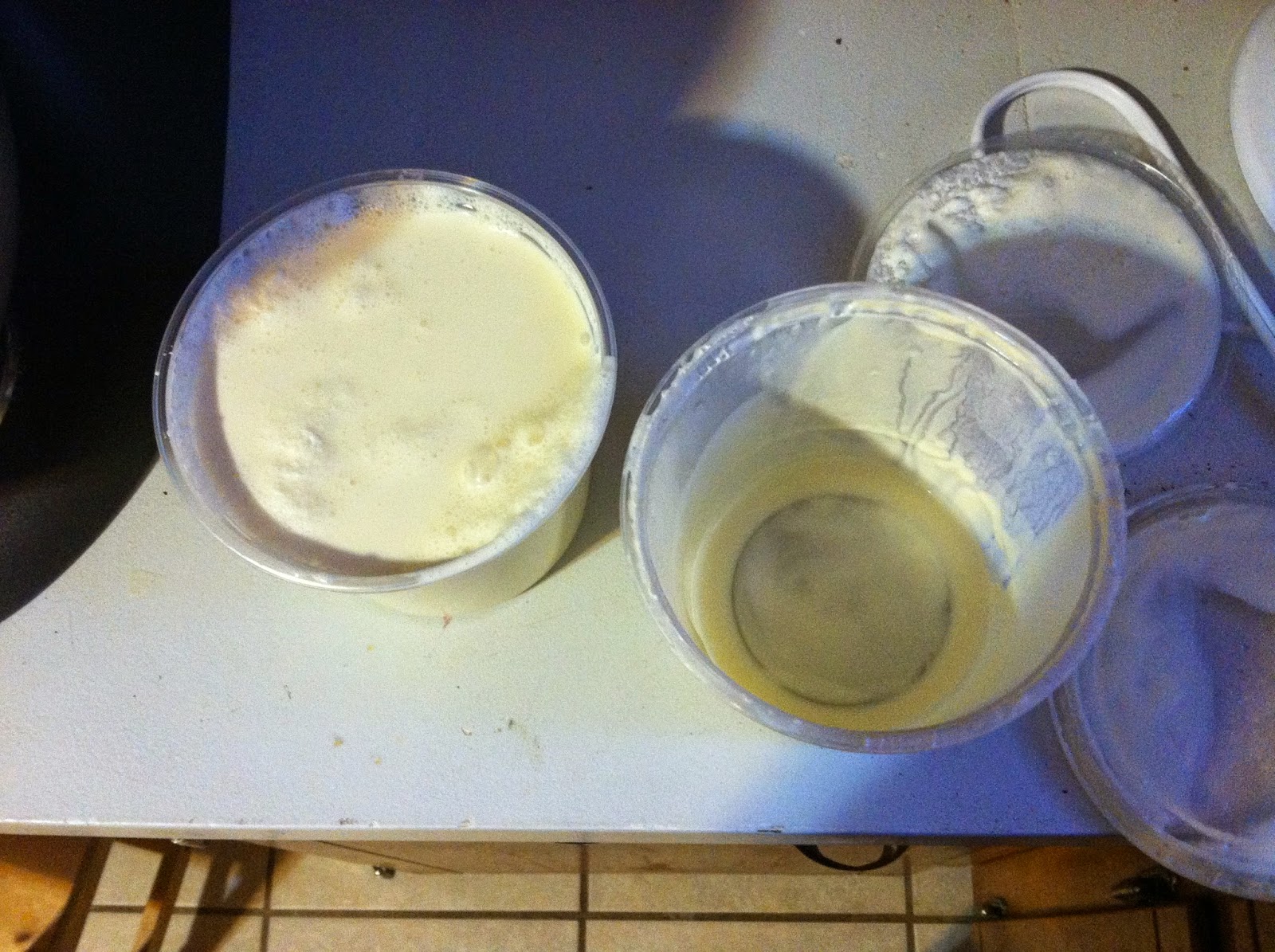
Except it's not just like butter.  It actually is real butter!  I just realized I've never given you a post on how I make butter.  I'm kind of embarrassed to do it, because it's not much of a "recipe," to speak of.  It's just a series of actions with one ingredient that takes about half an hour.

And that half an hour each week is totally worth it to me!  To have fresh, raw, local butter.  At a great price!  (Works out to about $6/lb for me.)

Here's what I do.

Each Monday evening, we pick up our milk from the co-op.  We usually get one gallon of milk, one pint of cream, and one dozen eggs per week.  We bring it home, and I pull whatever cream was left from last week out of the fridge.  I combine it with whatever cream I won't be using for recipes during the week from the new pint.  Usually it works out to about a pint or so of cream altogether.  Sometimes I wait until I have more cream built up and do a quart at a time.  Your preference.  The more cream you use, the longer it takes to curdle, but then you have more butter.  You can always freeze the excess if you'd rather do a big batch at once.


You have a choice at this point.  Do you want:

1)  Sweet cream butter?
      Pros:  neutral flavor, good for baking, can be made with cream straight out of the fridge.
     Cons:  shorter shelf life on the counter, leftover buttermilk is basically just skim milk and cannot be used as an acid in baking (unless you add some additional acid to it, like lemon juice or vinegar).

or

2)  Cultured cream butter?
      Pros:  slightly tangy flavor, European-style, longer shelf life on the counter, leftover buttermilk is cultured and behaves just like store-bought buttermilk in baking (that is, it acts as an acid with chemical leaveners like baking soda.)
      Cons:  not as good for baking because of flavor profile, the cream must sit and culture first at room temperature.

If you want to culture, it's really easy:  just sit the cream on the counter and leave it for 12-24 hours before you make butter.  Done.  I always make sweet cream butter, just because I prefer the flavor.

So here's how I make the butter:

I put the cream into my stand mixer with the whisk attachment.


I cover the whole thing with a dish towel (or you will splash buttermilk in places you didn't even know existed in your kitchen!).

I turn it on to a moderately high speed (maybe a 6 on my Kitchenaid), and let it whip.

Just leave it alone and let it do its thing.  It will turn into whipped cream,


then it will break and shrink back down,


and finally it will begin to separate into butterfat and buttermilk.


I stop it just one time, after the whipped cream has broken, to scrape the sides of the bowl and be sure it is all incorporated.  For a pint of cream, this stage generally takes about 20-30 minutes.  If you have more cream, it will take longer.

When it's fully broken, you will hear a lot of sloshing in the mixer bowl.  Stop the mixer and strain the butter away from the buttermilk.


Put the butter curds into a large mixing bowl.

Use the back of a wooden spoon to press as much moisture as you possibly can out of the curds.


Spread the butter around the bowl with the spoon and then push it together.  A lot of buttermilk will continue to come out of the butter.  Drain it off into the jar with the other buttermilk.  Really work as hard as you can to get the buttermilk out of the butter, because any liquid left in the butter is what causes it to spoil.  I usually knead the butter with the spoon for about 5-10 minutes.  Some people do this with their hands, but I've found my hands are way too warm and they just end up with melted butter smeared all over them and wasted.

Once you are satisfied that no more buttermilk is coming out, put your butter into a glass dish and either keep it on the counter to use immediately or in the freezer for storage.  I always keep some out so it's spreadable.  I find that the butter will taste sweet and good for 2 weeks in winter, and closer to 1 week in summer.


Enjoy!

[This post submitted to Fat Tuesday 2/24/15 and the HomeAcre Hop 2/26/15.]

Thursday, February 5, 2015

how i weaned off my antidepressant

Y'all have been so kind in responding to my last post about why it was the right choice for me to take an antidepressant.

Here's what I feel like pretty much all the time these days.  :)


And sometimes even like this!!

Prior to taking one, and even while I was taking the sertraline, my primary concerns were twofold:

1)  Dependence.  I'm not interested in chemical dependence of any kind, be it illicit or prescribed.

2)  Muting of natural feelings.  I was worried that I would feel like a zombie, or that my natural highs would be as blunted as my natural lows needed to be at that point.

#2 ended up not being a problem at all.  I felt calm and placid, but I was still able to laugh riotously or be brought to joyful tears by something beautiful or touching.  So, I no longer have that concern for myself.  I know that others have had the problem of emotional numbness, but it's important to remember that each body and brain has such individual chemistry that a lot of this can only be ascertained by trial and error.

#1 was what eventually brought me to the point of wanting to taper off the medication.  I wanted it to be a short-term help, until I got organized with an arsenal of natural remedies that could support my emotions.  So, while I was taking the sertraline, I researched and researched.  I consulted with my herbalist.  I talked to my doctor.  And this is what I came up with:

1:  Exercise/Sunlight/Fresh Air

Endorphins are not a joke!  They are your body's best natural drug.  I started the Couch to 5K program when Todd turned one in May, and I haven't looked back.  I have slacked off some and had to start back over several times, but the benefits of jogging are huge for me.  It's both physical and emotional:  I feel really good about myself for doing something positive for my health, and I have the actual physical boost of the endorphins.  I have to do pretty vigorous exercise to get a good rush.  I like to exercise outside as much as possible.  Nice fresh air and natural light also help me feel balanced.  I try to jog three times a week and take the kids for a good long walk twice a week.  I'm wanting to get back into a weekly yoga class as well, and I'm looking forward to hiking with the kids once Todd gets a little bit older and more steady.

2:  Balanced Diet

I won't say too much about this one, except:  a lot of sugar and junk makes me feel like crap about myself, and just like crap in general (again, both a physical and an emotional effect).  These are the dietary principles I strive (somewhat imperfectly) to follow, and I try to emphasize protein and fat over carbs.  I try not to get crazy about it, but I know I feel better when I eat better.  I have been posting weekly meal plans for awhile, if you're interested.  Too much caffeine makes me irritable and sleepless, as well, so I try to limit to one cup of coffee per day, before noon.

3:  Good Sleep

I am lucky in that I have never had trouble sleeping.  Unless I have too much caffeine in the afternoon or evening (see above).  But I do try to be in bed by ten or eleven each night.  Also, magnesium before bed helps me relax (see below).

4:  5-HTP (or St. John's Wort)

This was the single biggest supplement help I took while weaning from the antidepressant.  5-HTP is an amino acid that is converted to serotonin and melatonin in the body.  When you take it, you're basically giving your body more of the raw materials to make the neurotransmitters that lead to balance.  I took 50 mg twice a day, morning and night, for well over six months.  It's important NOT to take 5-HTP while you are still on any SSRI medication, as it can seriously mess up your brain chemistry to have both going at once.  St. John's Wort is another good herbal option (but is not one that I took), however, it's important to note that you should not take 5-HTP and St. John's Wort together.

5:  Vitamin D3

Basically, what can't Vitamin D do?  Your body uses it for everything.  Immune system, creation of hormones, regulating neurotransmitters.  There is a reason people get more depressed when the sun (the main natural source of Vitamin D for our bodies) is out less during the winter.  Vitamin D deficiency has definitely been linked to mild depression.  I take 5000 IU (5 drops of 1000 IU per drop) daily.  I just had my Vitamin D levels tested, though, and despite that level of supplementation, they were still borderline low!  So I've gone up to 6000 IU per day and am being retested in a few weeks.  It's important that you take D3, as it is best absorbed by the body.

6:  Fermented Cod Liver Oil

Really, this could be any fish oil.  The omega-3 acids in fish oil have a direct link to raised serotonin.  I choose to take fermented cod liver oil because it has a bunch of other benefits too.    Actually, the whole family takes it!  Here's my method on how we get it down, because it doesn't taste great.

7:  Magnesium

I'm a huge fan of magnesium - and did you know that most of us are deficient?  Particularly if you take supplemental calcium, you are probably lacking magnesium.  If you feel anxious, exhausted, have muscles spasms, cramps, or twitches, you probably need more magnesium.  And it's really not going to hurt you to take it.  (I used to get eyelid twitches all the time before I started taking it.)  Magnesium has been used to treat major depression.  It works on the neurotransmitter level by guarding the neuron from excess calcium and glutamate, which are excitatory and can eventually cause cell death.  It also reduces stress and brings on a feeling of relaxation.  I love to drink it at night before bed.  It makes me feel all warm and soft.  I take this brand, which tastes absolutely delicious as an added benefit.

8:  Kava Kava  

This was given to me by the herbalist in case of extreme irritability.  Kava kava is a root that has been used in the South Pacific for centuries.  They make it into a drink and take it ritually.  I just take a little bit of powder in water.  This is not to be taken regularly.  I have taken it maybe two or three times.  It gives you an immediate feeling of relaxation and being kind of "blissed out."  It works on the central nervous system, and as a muscle relaxant.

9:  Skullcap

Skullcap was recommended by the herbalist as well, and she mixed me up an herbal tea of skullcap, motherwort, and passionflower, with rose petals and lavender for flavor.  Together, we named my blend "Letting Go," which I think is really beautiful.  Skullcap is great for anxiety, and that feeling of wanting to crawl out of your skin.

10:  Motherwort

Motherwort is an herb that helps you feel safe and secure (like sitting in your mother's lap).  It does not numb your mind or cause sleepiness, just a release from anxiety.

11:  Passionflower

Passionflower is the final active herb in my anxiety/depression-reducing tea.  It's good for that feeling of being overwhelmed and anxious because you are exhausted from the demands of life.  I get that feeling a lot.  :)

Those are the best tools I have encountered for helping quell my natural anxiety, irritability, stress, depression, and feelings of being overwhelmed.  The ones I take daily are fermented cod liver oil, Vitamin D3, and magnesium.  I also incorporate exercise, fresh air, sunlight, good food and drink, and good sleep into my life daily!  I take my herbal tea sometimes, when I feel stressed.  The kava kava is for very acute moments only.  The 5-HTP I would probably start again if I began having extended feelings of being low and depressed.

I know that this post is long and involved, but I hope it can help someone who is ready to transition to a more natural way of managing your moods.  Believe me, I see absolutely nothing wrong with taking pharmaceuticals to manage depression.  But I know I was wishing I could find a more concise place that all of this was listed when I was ready to try something different.  Love and peace to you all!

[This post submitted to Fat Tuesday 2/3/15, Real Food Wednesday 2/4/15, and The HomeAcre Hop 2/5/15.]

Tuesday, December 30, 2014

want/need/wear/read

My kids get so much stuff for Christmas.  Like - so much stuff.  They have very doting grandparents, great-grandparents, friends, and teachers.  I really have not felt like there was much I could do to compete with that, and in fact, for their birthdays and Christmases so far, I've not really gotten them anything!  I will make whatever food they want on their special days, but I leave the material gift-giving to the professionals.

I started to feel a little guilty about this, though, and decided I would try out a strategy I'd heard about from friends:  give them four types of presents.

1)  Something they want.

2)  Something they need.

3)  Something to wear.

4)  Something to read.

So, how did Christmas 2014 stack up?

I think it went pretty well!  I decided to hand-make what I could, given my time constraints.


I knit Vicki a pair of soft socks in her favorite color (purple!) - so there is #3 for her.  And Todd needed a cross-stitched cuff for his stocking, so there is his #2.


Here are the finished products!  I'm really happy with them, and I'm glad I decided to stitch Todd's present, as I'd forgotten how enjoyable counted cross-stitch can be.

I also went to a local kids' gift store and bought a few items for them.


Here's the array:  a got them each a few Schleich animals, which are my favorite.  I got Todd a little Euro-style race car.  Vicki got some new triangular crayons.  One book for each of them.  They each got a few of their favorite beautiful satsumas.  You can see Vicki's socks and Todd's stocking topper here. Not pictured is another gift I gave to Vicki earlier in the week.  She had been begging for a pink Thermos cup and soup container every time we went to Target.  So I got them for her.

You can also see the hand-quilted and -stitched stocking my own grandmother made for me ("I Love Christmas").  I gave myself a couple of oranges too.  :)

In years to come, I intend to knit and felt a Christmas stocking for each of them, cross-stitch Vicki a stocking cuff as well, and stitch the cuffs onto the stockings.  But all that can wait until next year at least.

So, here's how it all broke out:

1)  Something they want:  Thermos cup and container for Vicki, race car for Todd.

2)  Something they need:  crayons for Vicki, stocking cuff for Todd.

3)  Something to wear:  socks for Vicki, didn't get around to this for Todd!  Fail.

4)  Something to read:  a simple Christmas-related book for each of them.

They have really loved all of this, in addition to the many others toys and treats they have received.  Funny enough, the thing they have loved playing with the most is our nativity!  They like keeping the wise men far away and then moving them a bit closer each day until Epiphany.  They also loved putting baby Jesus in the manger on Christmas Eve after church.  I love how this set is wooden and durable, and I don't mind at all if they want to play with it!  In fact, my heart just delights in hearing Todd lisp, "Baby Jesus!"


How have you approached gift-giving in your family?

Thursday, October 23, 2014

our morning cocktail

Are your mornings too stressful?  Trying to get kids up, dressed, fed, washed, not killing each other?  Trying to get your teeth brushed, coffee drunk, make sure you have your shirt on right side out and remembered to comb your hair?  Or is that just me?

I decided mornings were getting to be too much.  We all needed a cocktail.  You know, a little relaxation.

Wait, what?  Not that kind of cocktail.  My kids aren't stressing me out to the point of early morning drinking (yet).  No, I mean a nourishing, nutrient-packed cocktail.  One that gets our bellies and our brains in the right place for the day.  

After years of pondering how to get my kids to ingest the very few supplements that I want us to take, I came up with this sort of brilliant idea.  Mix them all together with a shot of something sweet, and get them to gulp it down first thing.  Here are the building blocks:

Fermented Cod Liver Oil (FCLO).  Cod liver oil was your great-grandparents secret to great health.  It was a nearly-universal morning dose for my grandparents.  They tell me how their moms used to line them up and give each kid a spoonful.  In fact, I just read an interesting article about breakfasts around the world, and cod liver oil is still very mainstream in the Nordic countries, where sunshine (and thus vitamin D) is limited.  FCLO is rich in vitamins A and D and is a real superfood.  

Probiotic.  I don't need to say much about this, since it has become so popular in mainstream health news.  Probiotics do more than just aid digestion, though.  Our guts generate much of our immunity to diseases, so keeping them healthy and balanced helps your health overall.  I like to use one that requires refrigeration, so the little bugs stay alive. This particular brand is for infants (I got it when Baby Todd was still Baby Todd), and we are just all using it until it runs out.  

Vitamin D.  Unless we are spending a ton of time in the sun, I supplement a little straight vitamin D3 for each of us.  The kids get about 1000 IU per day (which is one drop of this liquid).  I take 3-4 drops.  Really, it's hard to go overboard on vitamin D - although it can happen, and if you get several hundreds of thousands of IU, it can be toxic.

Something sweet to mix it all in.  Once winter really rolls in and we get our first box of fresh oranges, I will juice a couple and we will get the additional benefits of vitamin C and enzymes from the fresh juice.  For right now, I'm using the syrup left from canned peaches or pears.  It is so delicious.  


I measure all the supplements into the bottom of a 4-oz canning jar.  


Add the mixer, put the lid on, and shake shake shake until everything is well-mixed.  


And that's it!  We each get a little jar and slurp it down.  Todd actually really enjoys his.  Vicki and I take it more like medicine.  Sometimes I add a little Swedish bitters into mine to help avoid the fishy burps that FCLO can give me.  

I have really been proud of myself for finally figuring out a way that we can take these superfoods that are adding to our health.  How do you get your kids to take their supplements?

[This post submitted to Real Food Wednesday and Pennywise Platter 10/23/14, and the Homestead Barn Hop 10/27/14.]

Tuesday, October 21, 2014

homemade tomato paste

This is one of those posts that's almost like, "why?" Why would I want to make tomato paste when I can seriously get it for like fifty cents a can at Kroger?  How could going through all these many steps possibly make more sense than just buying the can?  I have a few reasons.

1)  Food preservation makes me happy.  I enjoy taking a fresh, raw product and turning it into something beautiful that safely sits on my shelf in glass.  It's almost like creating home decor and food at the same time.

2)  I can control the quality of the ingredients.

3)  Tomatoes canned in tin might leach metal, and most cans are lined with plastic to prevent the leaching.  I'm not sure that the plastic is that much healthier than leaching metal!  A lot of cans say "BPA free," but I'm just waiting for the other shoe to drop on plastic all the time.  I don't think BPA is the only problem.

So, with all those considerations in mind, I got me a 25-pound box of tomatoes from Bulk Natural Foods.  I roasted about a third and made salsa, and the rest I processed into tomato paste.

Here's kind of a conceptual framework I work with in making tomato products, by levels of concentration:

1)  You can just peel, can, and preserve whole tomatoes.

2)  You can cook them down a little and make stewed tomatoes, sauce or puree.

3)  You can cook them down further and make tomato butter, ketchup, or add sugar and make tomato jam.

4)  You can cook it down even further and make paste.

It's all about how much liquid you're trying to get out of the tomatoes before canning.

So here's what I did.

I slashed the bottom of each tomato, dropped it into boiling water for 2-3 minutes, then removed it into a bowl of icy water.  Leave it there for a minute or so.


When they were cool enough to handle, I slipped the peel from each tomato and put it in the compost.  I also cut out the cores.  Then I sliced them in half through the middle and used my fingers to ream out the seeds and juice.  I strained this juice into a jar and saved!  Fresh, delicious tomato juice.  Yum.  


I put the squeezed tomatoes into my crockpot, set to low.  I left them there overnight, with the lid slightly vented.  


In the morning, they were soft and had released a lot of liquid.  Working in batches, I pureed them in my blender.  An immersion blender would have been ideal for this, but I don't own one!  


After running through the blender, back into the crockpot the tomato puree goes.  I left the lid off for about 8 hours that day, and here's what it looked like: 


Wow!  Big difference, huh?  It's cooked down to almost 1/8th of its original volume.  You can tell you're getting close when it turns brick red and gets very thick.  So thick it won't even pour off a spoon.  I added about a teaspoon each of sucanat and sea salt at this point, but that's strictly optional.  

Then I sterilized some 4-oz jars in boiling water, filled with the hot tomato paste, wiped and lidded, and processed for 30 minutes in the water.  Voila!  Tomato paste.  25 pounds of these tomatoes yielded 32 oz of tomato paste, but your mileage will vary based on what kind of tomatoes you have and how juicy they are.  


[This post submitted to Pennywise Platter 10/21/14 and Real Food Wednesday 11/20/14.]

Monday, September 29, 2014

potato no more!

In general, I want to dislike neatly-packaged "programs" that lead to "results."  For instance:  Dave Ramsey.  He seems so slick.  Almost like some kind of snake-oil salesman.  All the little slogans - it just seemed like groupthink.  But then I read the book, and my previous church started running his program.  And dang it.  It works.  His principles (which are really just the sound personal financial planning that we no longer learn from family or in school) help people get out of lethal debt and manage their finances so they can faithfully give.  I really didn't want it to work.  But it does.  I've used the debt snowball myself to great effect, and currently only owe student loans and my mortgage.

Another program I loved to hate was Couch to 5K.  This is super-straightforward.  It's a program of walking/jogging that promises to get you to running a 5K by the end of nine weeks.  It entails three weekly workouts that take no longer than 30 minutes.  I've seen people talking about it for years.  But I scoffed.  And I seemed to think that somehow, magically, I would just get in shape without having to start somewhere.

For a year after the birth of each of my children, I have taken a drug called domperidone to help me be able to nurse them more fully.  Along with a delightful herbal tea, domperidone has been a lifesaver for me.  But the ugly side effect of domperidone is increased appetite and inability to lose weight.  And boy, did each of those nasty effects hit me like a ton of bricks.

My pattern with both kids has been:  I lose almost all the weight I gained in pregnancy within eight or ten weeks of birth.  Then, because of the domperidone, I gain it all back (and then some) over the course of the baby's first year.  I stop taking the drug after baby's first birthday and realize that I've got some serious work to get back to a healthy size.

So here I am three days after Todd's first birthday:  as big as I have ever been, even fully pregnant with either of my kids.


I realized, looking at that picture, that I needed to get serious - and fast - about getting fit.  I needed to get over my suspicion of a program like Couch to 5K.  So I jumped in.  I started the program.  I mapped the runs into a neat chart so that I could mark off finished workouts.  I breezed through the first week.  The second and third weeks took a little more effort, but I got it done.  I had bad foot and ankle pain that was immediately remedied by getting fitted for new shoes and inserts at our amazing neighborhood running store.  I found a super-duper sweet double jogging stroller on Craigslist for $85 and am now a dedicated Baby Jogger brand snob.  I was feeling really good about my progress, jogging with the kids on weekends, with the dog on my day off, and on our walking track at church during my lunch break.


And then I hit week 5, day 3:  walk 5, jog 20.  Twenty minutes of uninterrupted jogging proved to be really, really difficult for me.  I had to re-attempt probably two or three times before I was successful.  Weeks 7 and 8 really slowed me down.  We are getting into jogging pretty long portions:  25-28 minutes.  I will admit that I still have not finished the program! The final week is three workouts of walking 5 minutes, jogging 30 minutes.  I still can't quite do it.  But I work at it.  I jog 2-3 times per week.  And I feel amazing.


And I've lost a little over 20 pounds, to boot.  This is not the end of my "after" story, because I still have a long way to go.  This is really just the end of the beginning!  It's the beginning of me getting over my pride and my ridiculous objections to simple programs that encourage fitness.  I hope, if you're on the ledge, you can get over it too!

Friday, August 22, 2014

cheezin'

I'm back!  I'm alive!  I'm here!  I haven't written anything since last December.

Yikes.

Well, I'm back.  And I'm gonna take it slow.

One place I have decidedly NOT been absent is Facebook.  Oh, how I love to hate Facebook.  And yet, in this season of early bedtimes and limited adult contact, it's my lifeline.  Checking up on people, following conversations, trying to offer encouragement.  And the groups!  I love all the little niche interest groups I'm part of.  In fact, that's really probably the most useful thing that Facebook offers me.  Nashville Natural Parents, The Young Clergy Women Project, East Nashville, and more.  But my favorite is Real Food Nashville.  It's a community of people who are dedicated to sharing resources and information in helping more people find more real food.

One thing that folks do frequently on Real Food Nashville is organize group buys.  These are like little ad hoc co-ops that spring up around one product.  So I've been in a group buy for grass-fed gelatin.  Or one for coconut oil.  That kind of stuff.  It's where I found my half of a grass-fed steer last winter (so much more to tell you about that!  Best purchase EVER).  I bought some superior satsumas and Meyer lemons last winter from a farm in Chickamauga through RFN.  And now, a couple of times, I've bought the most amazing raw grass-fed cheese I've ever encountered in my life.


So what makes this cheese so fabulous?

It's raw.  The milk that goes into this cheese is never heated past about 100 degrees F.  If you go beyond that point, you begin to denature the milk and break down the naturally occurring enzymes that help make it easier to digest and better for your body.

It's grassfed.  Cows that feed on grass make milk that is superior.  Grassfed dairy is higher in a host of vital nutrients than grainfed dairy.  This article is a great starting point for why grassfed dairy is the way to go!

It's not that expensive.  Now, don't me wrong.  This is more costly than the Kroger brand sharp cheddar I sometimes pick up.  But consider this:  "raw" cheese (which is usually heated past the point that allows enzymatic activity) at Whole Foods is typically like $20/lb.  These big beauties were $7/lb.

It's ordered farm-direct.  No middle man.  Minimal shipping cost.  More money straight to the farmer.

It's delicious.  When we did our first order back in April, I was a little wary about ordering five pounds of cheese at a time, knowing that cheese doesn't freeze well.  Our family is not huge and it seemed like an awfully large amount of cheese.  Well, I can confidently say that we breezed through that block of cheese in weeks.  My kids begged for it.

So - if this sounds appealing to you, think about starting this kind of group buy in your area!  Get to know the farmers that are near you.  Find good prices.  Talk to them about their practices.  And then support them.  This has a been a huge part of my philosophy of getting out of the grocery store.  As much as I can, I buy what I need from farmers or in bulk, and then make the rest.

One of the reasons I stayed away from the blog for so long is that I began to feel that I was way out of the mainstream.  Like I'm describing a lifestyle or diet that sounds not only unattainable for some people, but frankly unattractive or just too much work.  I hope that's not the way this comes off.  Hell, I ate a Taco Bell burrito for dinner on Wednesday.


80/20, baby.  80/20.

Friday, September 6, 2013

mother's milk tea

I really discovered the power of herbs during my pregnancy.  Daily, I drank a strong tea of nettles and red raspberry leaf, sometimes with alfalfa added.  I believe that it helped keep my water weight down and gave me tons of nourishing minerals and vitamins to have a healthy, big baby.  The red raspberry leaf helped my uterus to be extremely strong and effective once labor finally began, and enabled me to have a very short one!

I had trouble producing enough milk for the entire time I nursed Vicki.  I ended up taking a drug called domperidone, which has a side effect of increasing lactation.  I decided to have domperidone ready again for when Todd was born, but I also wanted to see what kinds of herbs might help me.  I researched bagged mother's milk tea blends and figured out how to make my own.  Then you get the full power of beneficial herbs without the price tag that comes along with pre-bagged tea.  I also used two books that were extremely helpful in discerning how much of each herb to use:  The Breastfeeding Mother's Guide to Make More Milk, and the Nursing Mother's Herbal

Here are the herbs and seeds I've ended up including:

Alfalfa:  this leaf is very nutritious and provides a boost to your milk-making prolactin receptors.

Nettles:  are also packed with vitamins and minerals, giving more milk by making sure your essential nutrients are covered.

Blessed Thistle:  known for lifting depression and postpartum gloom, in addition to increasing milk supply.  

Dandelion Leaf:  supports the liver, helps you shed excess fluid, and makes your milk richer.  

Fennel Seed:  aids in the letdown reflex, making your milk more accessible.  I have particularly noticed this as compared to my last nursing experience with Vicki.  I let down more quickly and more often.  

Fenugreek Seed:  Dr. Jack Newman, the renowned breastfeeding expert, is a big fan of this one to increase milk production.  

Goat's Rue:  this is one of the only herbs actually known to increase mammary tissue - so it doesn't just help increase how much milk your glands are already making.  It actually helps make more glands!  That is why I add a larger proportion of this herb to my mix.

I mix up my own blend in these proportions:  2 parts nettle to one part each alfalfa, blessed thistle, dandelion leaf, fennel seed and fenugreek seed.  For my "parts," I use 1/4 cup measure.  I put it all in a big mason jar and keep it out on the counter.  I add the goat's rue separately to each batch of brewed tea I make.


Every night, I prepare my quart jar of tea for the next day.  I add 1/4 C of the first six mixed herbs from the jar above, as well as 2 T of goat's rue, to a quart-size mason jar.  I pour boiling water up to the top of the jar.  The next morning, I strain and funnel it into another jar and top it off with more water.  I sip it all day.  Just like with my pregnancy tea, I've found that plain water is very unappetizing to me now.  My body wants my herbs!  And I am making more milk.  Still not enough for all that Todd needs, but more than last time!

[This post is part of Fight Back Friday 9/20/13.]

Monday, July 8, 2013

puddin' pops

Vicki Jo has been loving her some popsicles lately.  We use our popsicle mold constantly, and I finally had the bright idea to buy wooden popsicle sticks so I could have more than four at a time in the freezer!  Now, I make a batch, stick in wooden sticks, and pop them out when they are frozen.  I store them in a plastic bag in the freezer, and make another batch!  There are three main varieties I make:  fruit flavors with simple syrup (look for a basil lime recipe soon . . . yum); smoothie pops with yogurt and fruit; and pudding!  I am always looking for ways to use up our weekly gallon of raw milk, and pudding is so nutritious and tasty (okay, minus the sugar . . . but still, it has egg yolks and milk!  And butter!).

So, first, obviously, you have to make pudding.  I make chocolate, but the flavor possibilities are endless.  I've toyed with different recipes, but the best one is just sugar, cornstarch, milk, egg yolks, chocolate, with some butter and vanilla added at the end.  After the pudding is done, I pour it into popsicle molds and freeze.  But you could just eat the pudding itself for dessert!

Chocolate Pudding Pops
1/4 C cornstarch
1/4 C sugar
3 C whole milk
2 egg yolks
6 oz dark chocolate, chopped
1 T butter
1 t vanilla

Whisk together cornstarch and sugar in a large saucepan.  Pour in milk and heat gently over medium-low, until the mixture bubbles.  Whisk frequently.


In a small bowl, whisk together the egg yolks.  Pour in a small amount of the milk mixture to bring the eggs up to temperature.  Then pour the egg and milk mixture back into the remaining milk in the saucepan.  Bring it up to a boil, whisking constantly.  When it is thick enough to coat the back of a spoon, pull it off the heat.  Add in the chocolate and stir until well-combined.


Whisk in the butter and vanilla. If you suspect there might be lumps, run the mixture through a fine mesh sieve before refrigerating or freezing.

To make pudding pops, pour into popsicle molds while still warm.


To eat as pudding, pour into a bowl and cover the surface with plastic wrap to prevent a skin from forming.  Refrigerate for several hours until chilled.


Friday, March 1, 2013

wash day

I pretty much always do the laundry on Saturday.  Even when I was in college, and I did one load per week (!), I would do it on Saturday.  I would take my clothes down to the basement laundry room, noting the time carefully.  You see, the washers and dryers locked for the time that they were cycling, but when they finished, they automatically unlocked.  If someone needed the washer or dryer, or wanted some of your clothes, they could swipe them if you weren't there right on time!  I really enjoy laundry, even when we have a lot of it.  It's a chore that requires not that much energy from me, and makes me feel really productive.  And folding satisfies my neatness compulsion.

These days, we are up to 5-6 loads per week.  Baby clothes, sheets, towels + pants, 1-2 adult colors loads, whites.  Diapers are their whole own thing, that I do as needed.

For several years, I'd been using the Target brand unscented free & clear detergent.  It was cost-effective and seemed to get our clothes clean.  I used a very tiny amount for our cloth diapers, and it didn't seem to build up.  But I thought there must be a better way.  One without optical brighteners (whatever those are!?) and other stuff that probably isn't that harmful . . . but if I could do it myself, why not?

I poked around the internets, and found the basic recipe for dry laundry detergent.  There is also a basic recipe for liquid/gel detergent, but it sounded like a lot more work and involved a five-gallon bucket.  The dry one is pretty simple:

1 C borax
1 C washing soda
1 bar grated laundry soap (I've been using Fels-Naptha, and the smell reminds me exactly of my grandparents' laundry room.  You could certainly use Ivory or something unscented if you preferred.)


Mix together and use 2 T per load  (I use about 1/2 T per load for diapers).  Note:  this is for old-fashioned top-loaders.  I have absolutely no experience with fancy energy-saving high-efficiency front-loaders, but I know they are a totally different beast.


I did find, after doing a couple of batches, that I need to grate the laundry soap by hand on a box grater, spread it on a baking sheet for a day or two to dry, and then grind into a powder in the food processor.  If you try to put it in the food processor while it's still "wet," it doesn't break down small enough and you can end up with small pellets of soap in your rinsed laundry.


I also found that over-stuffing the washer (of which I am frequently guilty) causes the detergent not to break down well.  It's a good impetus to keep the loads reasonably sized, which is better for your machine anyway.

I know some people worry about borax and whether it's safe or not.  I'm not concerned.  Here's a good article with lots of research about borax.

Finally, I try to wash everything in cold water, because I know it saves money and it's environmentally friendly.  But the detergent does do better in warm or hot washes.  I try to make up for it by line-drying when the weather is warm and dry.

This detergent works well.  The clothes are clean, smells and stains are gone, and they are much softer than when I was using storebought.  I particularly notice the sheets are very soft - they feel like they have a higher threadcount!

This may be one of those things that people think to themselves, Why would you do that?  Storebought detergent is not killing you!  It's not even that expensive, if you're already using a generic brand!  And that is true.  But sometimes I just like doing things myself.  It makes me feel good and proud of myself, somehow, when I use the one that I've made.  I can't really explain it.  But if you don't want to make your own detergent, then don't!  I would never force you.

Monday, February 4, 2013

he did it!

One of my favorite "the time that . . ." stories I have on this blog is about Jeff losing three different wedding bands within three years of marriage.

For his birthday in September, I half-jokingly gave him an IOU for a tattoo of a wedding band.  Jeff loves tattoos and always wants to get more, so he cottoned to the idea immediately.

Well today he went to Clarksville to see his buddy Matt - who happens to be a great tattoo artist, as well.

And then he sent me this picture!!


Along with the message, "You can never leave me!"  Ha!  Now that's an "I love you forever" statement!

Well, no more wedding bands for anniversary presents now.  The traditional fourth wedding anniversary present is apparently fruit or flowers.  Fruit or flowers!?  This will be the lamest one for Jeff by a long shot.

Wednesday, January 30, 2013

kansas day dinner!

We Kansans are a funny bunch.  My husband picked up on it right away when we met, noting that he'd never met someone who knew so much about the history and customs of her particular state.  Part of it has to do with our war-torn genesis into statehood, which centered in the area around my hometown.  Part of it has to do with being derided as a "flyover state," with little to offer the nation in terms of culture.  Part of it was the fact that our state mandated a month of Kansas history every January in the schools, so each year we learned about Kansas history, geography, foods, indigenous animals and plants, and more.  I can tell you without using Google that our state bird is the meadowlark, state flower is the sunflower, state motto is ad astra per aspera, state insect is the honeybee, state reptile is the barred salamander, and that our primary crop is wheat.

No matter how long I live away from Kansas, I don't think I will ever be able to say that I'm "from" somewhere else.  It's too far back in my blood - at least five generations.  And Vicki is a Jayhawker, too!  Even if she never remembers Topeka, where she was born, she can claim the title of a native-born Kansan.

The reason Kansas history centered on January is because January 29 is Kansas Day.  This commemorates the day that Kansas finally joined the union, as a free state, in 1861 (my elementary school was named Centennial because it opened on 1/29/1961 - the Centennial of Kansas Day).  Walking around my hometown, you might actually hear people wishing one another a happy Kansas Day.

I decided we needed to celebrate.  On Tuesday, the 29th, we had a Kansas Day dinner.  I served:

Buffalo Burgers and fixings (okay, okay - they were going to be buffalo, but that is surprisingly hard to find around here!  It would have meant a crosstown trip to Whole Foods at 12.99/lb.  No thanks!  I served beef)

Buns made of wheat flour

Oven fries with honey mustard to dip

Sunflower seed cookies

All the bolded foods are parts of Kansas agriculture and history.  We had a little crowd of Kansans over and talked geography, history, and just shared our wholesome Midwestern values.  It was lovely.

Sidenote:  Ugh, pregnant fat face + foregrounding myself.  The worst.


This may all sound like a fun and silly idea for a theme party - which it was - but it was also really important for me.  Moving away from Kansas felt like a betrayal of my ancestors and my history, and I wanted to commemorate our special day.  I was talking this over with my Grandpa Louis, who made the very valid point that the Reeves family came from England to Long Island, moved to Kentucky/Tennessee, and then only made the trip to Kansas in the mid-1800s.  So, really - I'm back where my people came from now!

Saturday, January 5, 2013

fruit snacks!

[This post submitted to Sortacrunchy's Your Green Resource 1/10/13.  ETA:  and featured (!) on 1/17/13.]

What kid (or - ahem - parent) doesn't love fruit snacks!?  Sweet, chewy, fruity, gummy . . . they are divine.  But if you're trying to avoid processed food, they are pretty much off the list.  Most have artificial dyes or flavorings.  Even the ones that contain no added sugar are not made from whole foods, but rather from different fruit juices and purees.  We don't even really drink any non-fresh-squeezed fruit juice anymore, because it's just as sugary as soda, and lacks the enzymes and other positive properties found in fresh fruit.

So I was just thrilled to see this recipe pop up on a roundup from Nourished Kitchen.  It comes from Thank Your Body, another great site with lots of natural and homemade beauty product recipes.  I adapted it a little based on what I found through several batches.

There are a few things I love about this recipe.  It has a short ingredient list.  The texture of the snacks is nice and gummy.  They keep at room temp or in the refrigerator, so are great for trips.  The baby is obsessed with them.  It's a keeper.

A big plus for me is the inclusion of gelatin!  This is like a natural protein powder made from the skins and bones of animals.  As I'm trying to keep my protein intake high during pregnancy, these are not just empty calories like sugared-up fruit snacks would be.  Each packet of gelatin contains 7 grams of protein (a little more than an egg!), so if you eat 1/6 of a pan of these snacks, you are doing pretty good.

Fruit Snacks


 2/3 C frozen or fresh berries (strawberries, raspberries, blueberries, etc)
1/3 C fresh-squeezed lemon juice (about two - three lemons)
1/3 C fresh-squeezed orange juice (about one large orange)
2-3 T honey
5 T gelatin (grass-fed is best, but if you're using what you can find at the store, use 6 1/4-oz packets)


Mix berries, orange and lemon juice in a small saucepan over medium-low heat until the berries are soft - about ten minutes.  Stir in honey until completely incorporated.


Let the mixture cool for five minutes, then pour into a blender and puree.


Pour the puree back into the saucepan and begin mixing in the gelatin, one packet at a time. Whisk hard!  You don't want lumps of gelatin.


After you've mixed in the gelatin, pour into a square glass baking dish and refrigerate until set (about 15 minutes).


Look - I didn't whisk hard enough and ended up with just a few clumps.
Cut into whatever shapes you desire and enjoy!


The white part is just foam from the blender that was set by the gelatin.  Although, if you wanted to get really fancy, I'm sure you could make different flavored layers!