Showing posts with label preserving. Show all posts

Wednesday, April 5, 2017

paneer

I promised this recipe post long ago, when I posted a photo of my paneer and butter on Facebook and had lots of interest from friends, wondering . . . what the hell is that stuff?

We have belonged to a milk co-op for about four and a half years.  We partner with an old-order Mennonite farmer in Kentucky, and about 8-12 families participate at any given time.  We take turns driving up there, visiting with Joseph, and bringing back milk, cream, and eggs.  It has been a phenomenal experience, and I'm so happy to be a part of it.  I love showing the kids the farm and the animals and where our food comes from.  Plus the drop point has been my backyard for the past few years, which makes it pretty easy for me.

The upshot, though, is that I pretty much always have a gallon of milk and a pint of cream waiting for me to do something.  We don't drink a ton of milk straight-up in my household.  Todd likes a glass here and there (he demands "fresh milk"), I like it in coffee.  But I get a gallon every week, rain or shine, and so I have had to get creative with how I use it up.

I skim the cream from the top of the gallon, combine it with my pint of cream, and make butter every week or two.  This has made me into a huge butter snob.  I only like my bright yellow butter now, and a lot of mornings the kids just have bread and butter and honey for breakfast.

I also make and freeze a lot of paneer.  I got super into making Indian food in the last couple of years.  It's pretty easy and it makes your house smell like exotic heaven.  Paneer is kind of the Indian equivalent to tofu.  It's a vegetarian protein staple that can pick up pretty much any flavor you combine it with.  Making it is an adventure in easy cheese-making:

Paneer . . . to the left, to the left.
Paneer
You will need milk, lemons, a big pot, a colander, cheesecloth (or an old clean pillowcase), a couple of plates, and some heavy cans.

Pour 8 cups of milk into a large pot.  Heat over medium until it begins to boil.  (This may take about twenty minutes - stir continuously near the end so it doesn't scald to the bottom.)

When it boils, pour in 1/4 C fresh lemon juice (no seeds! - you can also use bottled in a pinch).  The milk should begin to curdle immediately.  If it doesn't, add a little more lemon juice.

Drop the heat to low and stir the curds together gently for about five minutes.  You want to stir in such a way that you are sort of bringing them together, rather than smashing them apart.

Wet the cheesecloth and put it in the bottom of the colander.

Drain the curds into the lined colander.  Tie the ends of the cheesecloth together to make a little sack of curds.  Hang it from your kitchen faucet to drip for five minutes.

After the curds have drained five minutes, take the cheesecloth ball and twist it so that the ends are off to one side.  Place the ball on one plate, smash the ball down a little and put another plate on top of it.  Weight the top down with a couple of cans and let it drain for another twenty minutes or so.

Once the draining is over, remove the cheesecloth and dice the paneer into 1-inch cubes.  Use immediately or freeze for later!

How do I use it?  It's great in pretty much any Indian recipe!  Saag paneer, paneer tikka masala, and matar paneer are my favorites.  I will post a recipe for one of these in the next few days - this post already seemed too long and overwhelming!

Tuesday, March 10, 2015

homemade ricotta

One of the things that has been so fun and interesting for me as I ventured into a real-food diet has been the evolution of my concept of consumer choice.  For instance, your standard American mom makes a grocery list based on some recipes she wants to make (or maybe she doesn't even make a list - she just goes to the store and sees what looks good), goes to the grocery store, buys what she needs to make what she wants, and goes home.

I'm kind of doing things backward now!  I buy a half-cow in various cuts, then I look in my deep freeze at the beginning of the week and think about what I can make with what I have.  I get my CSA box and see what will spoil first, and plan on cooking those vegetables early in the week.  And we do a static dairy order each week - we can only change at the new order for the month.  So, if I ordered a gallon of milk, I get a gallon of milk each week, whether I want it or not.  And then I need to figure out what to do with it before it sours!

This may sound like a lot of work, but I really think it's a lot of fun.  It's about being resourceful and imaginative.  And once your brain gets used to shifting the order of operations a bit, it becomes second nature.  

Preserving dairy is a great extension of this resourcefulness.  Whatever we don't bake with or drink straight up or in coffee gets turned into butter, yogurt, puddingice cream, sherbet, mozzarella, ricotta, or ricotta salata.  I have shared most of these recipes with you already, but today let's talk ricotta!  


Ricotta is really the easiest soft cheese to make (aside from labneh, which is just strained yogurt).  And the uses are endless!  You can ripen it in the fridge to make ricotta salata, which is a salted, dried, aged version.  You can dollop it on a white pizza.  You can mix with salt, olive oil, and fresh herbs for a nice dip.  You can fold it into a cheesecake.   You can mix it into pasta (a traditional lasagna is my favorite!).  It has a mild, creamy texture and flavor that really make it versatile.  

So here's how you do it.


Start with a quart of whole milk.  (Raw, pasteurized, whatever.)


Heat gently to 95 C (~205 F).  I do this over medium heat, stirring frequently.


Meanwhile, mix 1/2 teaspoon citric acid with a few tablespoons of cool water.


When the milk is up to temp, pull it off the heat and stir in the dissolved citric acid.  The milk will begin to curdle immediately.  Cover and leave it for half an hour.


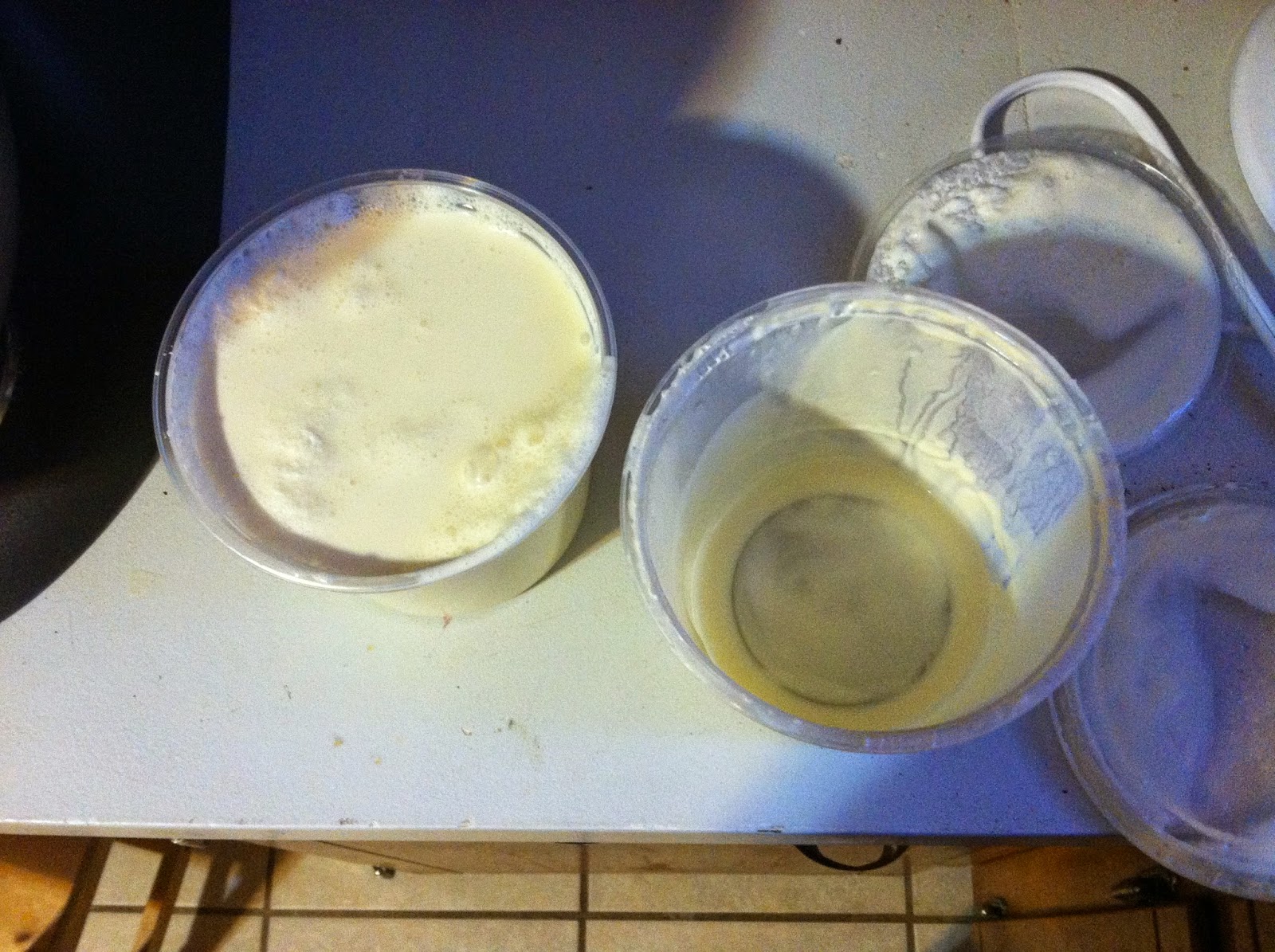
This is what it will look like when the half-hour is up - totally separated into curds and whey.


I use a ricotta strainer basket to drain off the whey.  I just discard it.  Some people save it to feed to their plants or things like that.  The whey at this point has lost all its probiotic quality due to being heated so high, so it's not a very useful dietary supplement.  You can strain it to your desired dryness. 


After straining mine for about an hour, I turn it out into a container.  

And there you have it!  Fresh, creamy, homemade ricotta, waiting in your fridge for you to eat it up!

From a quart of milk, I will get about 8 ounces of ricotta.

Have you ever ventured into cheesemaking?  Tell me about it!

[This post submitted to Fat Tuesday 3/10/15 and Simply Natural Saturday 3/7/15.]


Thursday, February 26, 2015

like buttah


Except it's not just like butter.  It actually is real butter!  I just realized I've never given you a post on how I make butter.  I'm kind of embarrassed to do it, because it's not much of a "recipe," to speak of.  It's just a series of actions with one ingredient that takes about half an hour.

And that half an hour each week is totally worth it to me!  To have fresh, raw, local butter.  At a great price!  (Works out to about $6/lb for me.)

Here's what I do.

Each Monday evening, we pick up our milk from the co-op.  We usually get one gallon of milk, one pint of cream, and one dozen eggs per week.  We bring it home, and I pull whatever cream was left from last week out of the fridge.  I combine it with whatever cream I won't be using for recipes during the week from the new pint.  Usually it works out to about a pint or so of cream altogether.  Sometimes I wait until I have more cream built up and do a quart at a time.  Your preference.  The more cream you use, the longer it takes to curdle, but then you have more butter.  You can always freeze the excess if you'd rather do a big batch at once.


You have a choice at this point.  Do you want:

1)  Sweet cream butter?
      Pros:  neutral flavor, good for baking, can be made with cream straight out of the fridge.
     Cons:  shorter shelf life on the counter, leftover buttermilk is basically just skim milk and cannot be used as an acid in baking (unless you add some additional acid to it, like lemon juice or vinegar).

or

2)  Cultured cream butter?
      Pros:  slightly tangy flavor, European-style, longer shelf life on the counter, leftover buttermilk is cultured and behaves just like store-bought buttermilk in baking (that is, it acts as an acid with chemical leaveners like baking soda.)
      Cons:  not as good for baking because of flavor profile, the cream must sit and culture first at room temperature.

If you want to culture, it's really easy:  just sit the cream on the counter and leave it for 12-24 hours before you make butter.  Done.  I always make sweet cream butter, just because I prefer the flavor.

So here's how I make the butter:

I put the cream into my stand mixer with the whisk attachment.


I cover the whole thing with a dish towel (or you will splash buttermilk in places you didn't even know existed in your kitchen!).

I turn it on to a moderately high speed (maybe a 6 on my Kitchenaid), and let it whip.

Just leave it alone and let it do its thing.  It will turn into whipped cream,


then it will break and shrink back down,


and finally it will begin to separate into butterfat and buttermilk.


I stop it just one time, after the whipped cream has broken, to scrape the sides of the bowl and be sure it is all incorporated.  For a pint of cream, this stage generally takes about 20-30 minutes.  If you have more cream, it will take longer.

When it's fully broken, you will hear a lot of sloshing in the mixer bowl.  Stop the mixer and strain the butter away from the buttermilk.


Put the butter curds into a large mixing bowl.

Use the back of a wooden spoon to press as much moisture as you possibly can out of the curds.


Spread the butter around the bowl with the spoon and then push it together.  A lot of buttermilk will continue to come out of the butter.  Drain it off into the jar with the other buttermilk.  Really work as hard as you can to get the buttermilk out of the butter, because any liquid left in the butter is what causes it to spoil.  I usually knead the butter with the spoon for about 5-10 minutes.  Some people do this with their hands, but I've found my hands are way too warm and they just end up with melted butter smeared all over them and wasted.

Once you are satisfied that no more buttermilk is coming out, put your butter into a glass dish and either keep it on the counter to use immediately or in the freezer for storage.  I always keep some out so it's spreadable.  I find that the butter will taste sweet and good for 2 weeks in winter, and closer to 1 week in summer.


Enjoy!

[This post submitted to Fat Tuesday 2/24/15 and the HomeAcre Hop 2/26/15.]

Thursday, November 6, 2014

making mozzarella

Cheese.  Glorious, homemade, creamy, cheese from grass-fed cows living a perfect Mennonite life.  Dudes, it just doesn't get better than this.

We get a gallon of milk from our farmer every week, rain or shine.  Because my kids are little, we struggle to drink the full gallon each week and usually have between 1 and 2 quarts left.  I refuse to dump it, so it either becomes yogurt, ice cream, or cheese.

My friends Parth and Julianne gave me a stupendous gift for my birthday this year -a cheese-making kit!   It had everything I need to make ricotta, ricotta salata, mozzarella, and burrata.  Do you know the joy of making a lasagna in which every item has been made from scratch, including the cheese?  It's an intense amount of joy.  Ricotta is easy and fast, and ricotta salata is easy but takes time to cure.  Mozzarella, on the other hand, is a little bit hard.  There are some elements to it that are sort of like bread-baking - you just have to do it over and over and then you know.  But I promise that it's worth it.  The taste just doesn't compare to what you can buy at the grocery store.

Let's get started, huh?  Cheese awaits us.


Cast of characters:  a half-gallon of good milk.  Doesn't have to be raw, but use the best-quality whole milk you can find.  Citric acid, calcium chloride, and rennet can all be found at cheese-making supply stores, or ordered online.  I've also found that a lot of brewing-supply shops carry cheese-making stuff.  If you're local to Nashville, All Seasons Brewing on 8th Ave. S. has everything.  And salt!


Start by putting the cold milk in a pot and adding 1 mL of calcium chloride, along with 1 t citric acid diluted in 2 T cool filtered water.


Heat the milk gently over medium, stirring constantly, until it reaches 32 C.  Have ready 1 tablet vegetable rennet dissolved in 2 T cool filtered water.  Having a good thermometer is essential!


When the milk reaches 32 C, add the rennet and stir briefly to dissolve.  Then cover the milk and let it sit for 30 minutes or so, until the curd is firmly set.  You can tell this by cutting into it slightly with a knife.  If it makes a clean cut, you are ready to go.  If not, leave it for awhile longer.


If the curd is ready, use a long knife to cut it into a checkerboard pattern.


Then place the curds back over medium heat, stirring constantly, until they reach 42 C.  They will change in texture during this time and become more stretchy and pulled-together.

Once the curds reach 42 C, dump them into a colander lined with cheesecloth, an old clean pillowcase, or a floursack towel.  Save some of the discarded whey if you are wanting to store your cheese after it's done.


Let the curds drain while you prepare your stretching water and your ice water.  Rinse out the pot you heated the curds in and fill it with fresh water.  Heat that water to 70 C and then remove it from heat.  While it heats, fill a medium bowl with cold water and add some ice and salt.


Okay, stretching.  This is really the tricky part.  I use rubber gloves because that hot water is really a little too hot for comfort.  Gather your curds together into one mass, and dip it into the hot water.  Leave it for about 10 seconds.  Pull it out of the water and begin stretching it like taffy.  Hold it with one hand and use the other to pull it away from you like a slingshot.  When it starts breaking rather than stretching, dip it back into the hot water for another 10 seconds.  Keep repeating this process of stretching and heating until it stretches smoothly and looks glossy.  Start stretching it into a ball by making a small circle with your fingers and palm and forcing it through the opening.  Try not to roll it, but rather mold it into a ball.  Once it is properly stretched and molded, drop it into the ice water.  Leave it there for 10 minutes or so, then it is ready to serve!  If you wish to store it, add a pinch of citric acid to the reserved whey and keep the cheese submerged in that in the refrigerator.

Yum!  I seriously have trouble not just slicing up this whole thing and eating it plain.


It will still have quite a lot of the natural moisture of the milk still in it, so if you want to grate it, it needs to be pressed and dried a bit first.  I tend to preferred it sliced rather than grated.  This mozzarella is an absolute essential to our Friday pizza nights.  I hope you enjoy it as much as we do!

[This post submitted to Real Food Wednesday 11/4/14 and Pennywise Platter Thursday 11/5/14.]

Tuesday, October 21, 2014

homemade tomato paste

This is one of those posts that's almost like, "why?" Why would I want to make tomato paste when I can seriously get it for like fifty cents a can at Kroger?  How could going through all these many steps possibly make more sense than just buying the can?  I have a few reasons.

1)  Food preservation makes me happy.  I enjoy taking a fresh, raw product and turning it into something beautiful that safely sits on my shelf in glass.  It's almost like creating home decor and food at the same time.

2)  I can control the quality of the ingredients.

3)  Tomatoes canned in tin might leach metal, and most cans are lined with plastic to prevent the leaching.  I'm not sure that the plastic is that much healthier than leaching metal!  A lot of cans say "BPA free," but I'm just waiting for the other shoe to drop on plastic all the time.  I don't think BPA is the only problem.

So, with all those considerations in mind, I got me a 25-pound box of tomatoes from Bulk Natural Foods.  I roasted about a third and made salsa, and the rest I processed into tomato paste.

Here's kind of a conceptual framework I work with in making tomato products, by levels of concentration:

1)  You can just peel, can, and preserve whole tomatoes.

2)  You can cook them down a little and make stewed tomatoes, sauce or puree.

3)  You can cook them down further and make tomato butter, ketchup, or add sugar and make tomato jam.

4)  You can cook it down even further and make paste.

It's all about how much liquid you're trying to get out of the tomatoes before canning.

So here's what I did.

I slashed the bottom of each tomato, dropped it into boiling water for 2-3 minutes, then removed it into a bowl of icy water.  Leave it there for a minute or so.


When they were cool enough to handle, I slipped the peel from each tomato and put it in the compost.  I also cut out the cores.  Then I sliced them in half through the middle and used my fingers to ream out the seeds and juice.  I strained this juice into a jar and saved!  Fresh, delicious tomato juice.  Yum.  


I put the squeezed tomatoes into my crockpot, set to low.  I left them there overnight, with the lid slightly vented.  


In the morning, they were soft and had released a lot of liquid.  Working in batches, I pureed them in my blender.  An immersion blender would have been ideal for this, but I don't own one!  


After running through the blender, back into the crockpot the tomato puree goes.  I left the lid off for about 8 hours that day, and here's what it looked like: 


Wow!  Big difference, huh?  It's cooked down to almost 1/8th of its original volume.  You can tell you're getting close when it turns brick red and gets very thick.  So thick it won't even pour off a spoon.  I added about a teaspoon each of sucanat and sea salt at this point, but that's strictly optional.  

Then I sterilized some 4-oz jars in boiling water, filled with the hot tomato paste, wiped and lidded, and processed for 30 minutes in the water.  Voila!  Tomato paste.  25 pounds of these tomatoes yielded 32 oz of tomato paste, but your mileage will vary based on what kind of tomatoes you have and how juicy they are.  


[This post submitted to Pennywise Platter 10/21/14 and Real Food Wednesday 11/20/14.]

Monday, December 9, 2013

i love you a bushel and a peck . . .

Guys'n'Dolls?  Anyone?  Okay whatever.

I'll cut straight to the chase.  We've been buying bushels of apples for $22.75 from Bulk Natural Foods.  (I will do another post on BNF soon, but let it suffice to say that if you are in middle Tennessee and not taking advantage of this co-op, you are a fool!)

And what does one do with a bushel of apples, especially if one doesn't have a spare refrigerator or other cold cellar in which to store them?

One does what one can.

Which includes:  applesauce, pie filling, eating out of hand, dehydrating, cider.

First, a word about varieties.  We were able to pick from about fifteen different kinds of apples, and I had no idea what I was doing.  I knew that Red Delicious are often mushy, that Granny Smith are too tart for me to eat plain, and that the rest were somewhere in between.  For our first bushel, I ordered Cortlands.  I got the box, tore it open, pulled a rosy red fruit out to taste, and . . . it . . . mushed between my teeth.  Nothing more disappointing than wanting to crunch into an apple and getting mush.  But they made stupendous sauce and really good, thick, pectin-y cider.  They also had a creamy white flesh that dried really nicely.

Second go-round, I went with Cameos.  Got the box, ripped it open, picked one up, said a little prayer . . . and . . . CRUNCH!  Perfection.  Lovely, firm, crisp, juicy flesh.

For winter storage, I read up on how to keep them in a cooler in the backyard.  Apples need to be between 28 and 30 degrees for optimal lifespan, so a cooler in the shade in a Nashville winter is about right.  I packed them in layers between newspaper in a regular old Igloo cooler.  Make sure all the apples are good, because you know what they say about one bad apple . . . (it spoils the whole bunch, girl).


For sauce, you don't really need a recipe.  4 pounds of apples yields about 1 1/2 quarts of sauce.  From my first bushel, I put up 12 half-pints to give out for Christmas presents.  I just peeled, cored, and quartered 8 pounds of apples, added in a cup of water, and threw in a star anise and a few big chunks of fresh ginger.  I stewed it all until it was quite soft - maybe 2 hours.  At that point, the apples had fallen apart and the texture was just slightly chunky.  If you wanted it smoother, you could mash it or put it through a food mill.  I heated the jars, removed the star anise and ginger chunks, and funneled it into my half-pints.  Processed in a boiling water canner for 15 minutes.  Done!  I'm getting ready to put up a few more quarts this week for family usage through the winter.

I'm going to make pie filling this week with this recipe:  spiced apple pie filling.

For cider, we are lucky enough to have friends from church with an old-fashioned cider press!  (Hi Elaine!)  We went up there a couple of weeks ago for supper and cider pressing.  Vicki Jo got to experience a hen house for the first time, and was totally freaked out as she helped collect the eggs.  The Cortlands made great cider, but the yield wasn't too high.  About a half bushel yielded only a half gallon of cider.  We tore through that in about two days!  Freshly-pressed cider is not even comparable to storebought pasteurized cider.  But I'll drink that too.  The Cameos are much juicier, and I suspect they would yield more cider if pressed.

And finally:  dehydrating!  I don't have a fancy-pants dehydrator, and even if I did, I would have nowhere in my dang house to put it.  But I can do one better:  a giant convection oven at my place of employ!


I do about ten apples at a time.  Peel, core, slice thin, lay out on parchment (made this mistake once - never again!), put into the oven on lowest temperature and high convection until nice and dry - about 3 or 4 hours.


These are so addictive.  Like potato chips but really good for you and packed with fiber and with no nasty oils.  I can tear through a gallon size bag by myself in an evening.

So!  Apples.  There you have it.  Buying in bulk is super-economical (I'm paying roughly 55 cents per pound, which is about a third what these varieties cost at the market), and makes you feel really homemaker-ish as you stock your shelves with stuff that you made!

[This post submitted to Real Food Wednesday 12/11/13, Unprocessed Fridays 12/13/13 and Fight Back Friday 12/13/13.]